

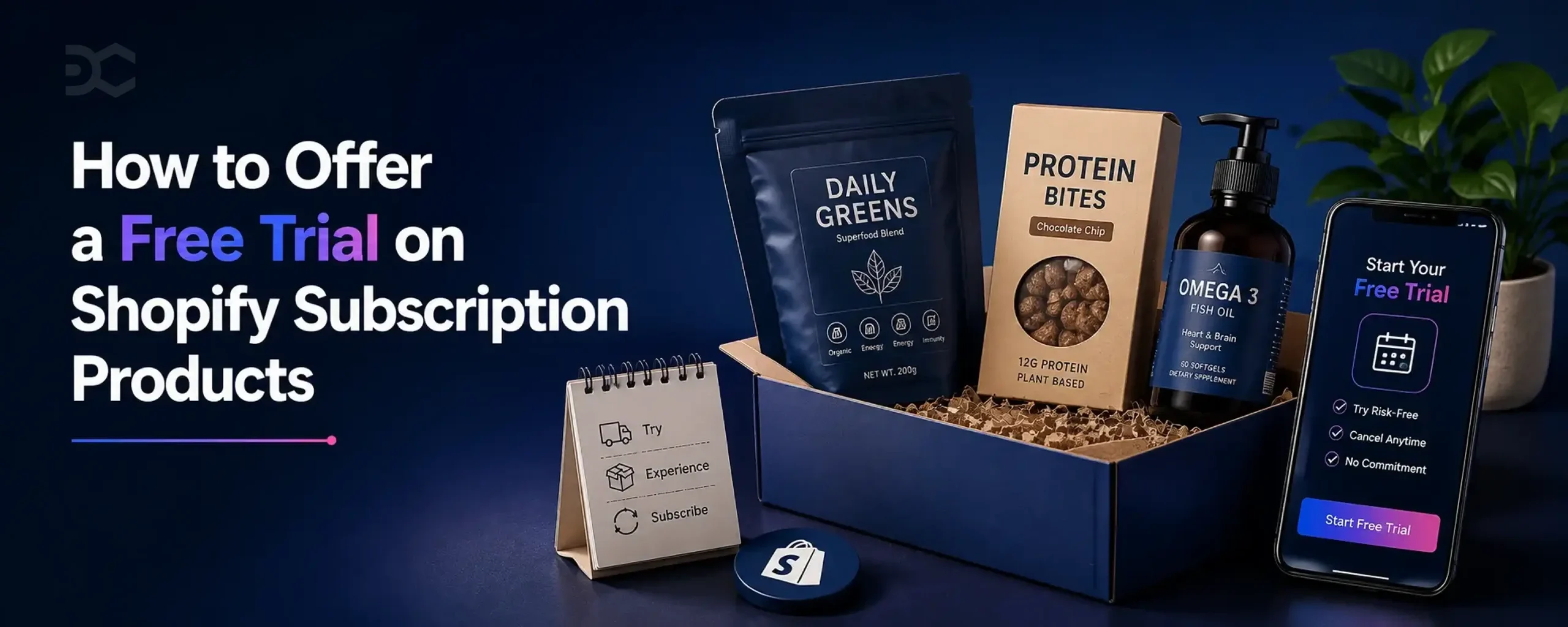
How to Offer a Free Trial on Shopify Subscription Products
- Updated: August 11, 2026
Table of Contents
Quick distinction before anything else: the free trial in question is the one you offer your customers on your subscription products, not Shopify’s platform trial for new merchants. If you sell coffee, supplements, pet food, or subscription boxes and want shoppers to try before they commit, you’re in the right place.
Here’s what most merchants discover too late: Shopify has no built-in trial feature for subscription products. There’s no toggle in your admin that says “add a free trial.” Every Shopify subscription free trial you’ve seen in the wild, from the $0 first box to the $1 sample, runs on a workaround.
You’ll see all three ways to build one, which trial model fits your margins, the compliance rules that shifted in 2025 and 2026, and the break-even math that tells you whether a trial pays for itself before launch.
Can You Offer a Free Trial on Shopify?
Yes, you can offer a free trial on Shopify subscription products, but there’s no built-in option for it. Merchants build trials one of three ways: a 100% discount on the first order, a trial product that swaps to the paid product, or a subscription app with trial rules.
The reason is structural. Shopify’s selling plans define billing and delivery frequency, but they have no concept of a trial period, so the platform can’t delay or zero out the first charge on its own. Anything that looks like a trial is engineered around that gap.
One thing all three methods share: the customer’s card still gets saved at checkout, even on a $0 order. That vaulted payment method is what makes the charge after the trial possible.
Which workaround you pick affects your checkout copy, your chargeback exposure, and how much you can automate. Each method, with setup steps and failure points, is broken down below.
Should Your Store Offer a Free Trial?
Do free trials increase subscription conversions? Yes, but only when the product would have re-sold itself anyway. A trial removes the risk of trying you; it cannot manufacture repeat demand that isn’t there. So the decision is product economics, not marketing preference.
When Trials Work
Trials perform best on consumables with natural repeat behavior: the customer runs out, and running out is the re-order trigger. Coffee, supplements, pet food, and snacks all qualify. If you’re starting a coffee subscription business or selling pet food subscriptions, a trial simply accelerates a buying pattern the category already has.
The second condition is margin. You fund every trial out of pocket, so one converted subscriber has to pay back several giveaways. Strong-margin consumables clear that bar comfortably; commodity resale products rarely do.
When to Skip Them
Skip trials when your product margin is thin or your COGS is high. Giving away a $30-cost item to win a $35-a-month subscriber is a slow way to lose money.
Skip them for durables and one-off purchases too. A knife set has no natural re-order moment, so a trial there is just a discount with extra steps. For catalogs like that, the other ways of getting subscribers on Shopify will outperform any trial, and none of them require giving product away. And if you don’t know your subscriber lifetime value yet, pause: without that number you can’t tell whether your trial is acquisition or charity.
The 30-second self-check before you build anything:
- Does the product get used up and re-ordered on its own?
- Is your gross margin above 60%?
- Do you know your subscriber LTV?
If all three come back yes, go ahead and build the trial. If even one is a no, fix that gap first. A trial layered on top of a broken number doesn’t fix anything, it just makes the problem more expensive every month.
5 Free Trial Models for Physical Subscription Products
“Free trial” is not one offer. It’s five different structures with different upfront costs, abuse risk, and legal weight, and the model you pick decides your checkout copy, your margin math, and half your compliance work before you touch a single setting.
1. $0 Trial + Paid Shipping
The product is free and the customer pays only shipping, usually $4 to $6. That small charge validates the card and keeps the offer feeling free at the same time. A skincare brand shipping a minis kit for $4.95 that rolls into a $39-a-month routine is the classic version. Conversion at signup is the strongest of the five, and so is the freebie-hunter problem.
2. The $1 to $5 Paid Sample
A token price on a trial-size product. Real money changing hands filters out people collecting freebies and gives your gateway an actual transaction instead of a $0 authorization. Think a $1 sample bag of coffee that converts into a $24-a-month plan. You’ll sign up fewer people than a $0 offer and keep a noticeably better share of them.
3. Free Welcome Kit With Commitment
The first box is free, tied to a minimum stay of one or two paid renewals. A pet food starter kit, bowl and scoop and a week of food, free when the customer commits through month two. The commitment protects your giveaway cost, but bury it in fine print and it resurfaces later as chargebacks.
4. Discounted First Box
Not a trial at all, and that’s the appeal. In the free trial vs first order discount question, the discount wins whenever your COGS is too high to give product away. It runs inside a standard subscribe and save setup, “50% off your first box” style, with the lowest risk of the five and the least magnetic hook.
5. Opt-In vs Opt-Out Billing
This one is not an offer. It’s the consent structure underneath whichever offer you run. An opt-out trial bills automatically when the trial ends unless the customer cancels; it converts far better and attracts nearly all the regulatory attention. An opt-in trial asks the customer to actively confirm the paid plan; fewer convert, but consent is clean and disputes are rare. Most US physical-product brands run opt-out. Know which one you’re running, because the compliance rules ahead treat them very differently.
Once the model is picked, the build comes next.
How to Set Up a Free Trial on Shopify: 3 Methods
There are exactly three ways to build a trial on Shopify: a discount hack on a selling plan, a product-swap automation, or an app that manages trial rules natively. They produce the same thing at checkout and behave very differently after it. The difference is where the trial logic lives, and that decides what breaks when something goes wrong.
Method 1: 100% First-Order Discount on a Selling Plan
The oldest workaround. You take a standard selling plan and zero out the first charge.
- Create a selling plan with your delivery frequency (say, every 30 days).
- Set the discount type to percentage and the first-order value to 100%.
- Configure the discount to drop back to 0%, or to your ongoing subscriber discount, after the initial order.
- Publish and test with a live checkout.
It works, and the flaw shows up immediately: checkout still reads like a paid subscription. The customer sees $0.00 today with a recurring-total line underneath, because Shopify is rendering recurring billing copy, not trial copy. Some merchants edit the checkout text to explain the trial manually. Skip that step and confused customers become your future disputes.
Method 2: Trial Product + Swap Workflow
Here you run two products: a $0 trial version and the full-priced subscription version, with an automation that swaps one for the other when the trial ends. This is the classic free trial to subscription workflow.
- Create both products, each with its own selling plan.
- Set the trial product to subscription-only. This step is not optional: leave a one-time purchase option open and people will order the free version on repeat with zero commitment attached.
- Build the automation that swaps the trial product for the paid product after the first cycle.
- Keep both products unpublished until the swap is tested end to end.
The risk sits in step 3. If the swap fails silently, subscribers keep receiving free product until someone audits the order list. And even when it works, the customer portal now shows a product the customer never chose, which reads like an error to them and generates support tickets for you.
Method 3: App-Managed Trial Rules
The difference with app-managed Shopify subscription free trial setup is that the trial is a rule, not a rewiring. Apps built with trial support define the trial inside the plan itself, so there are no duplicate products and no swap automation to babysit.
The flow is similar across apps that support it:
- In your subscription app, open the plan, rule, or offer settings.
- Create a new rule and choose the trial offer type.
- Set the trial length and the price billing resumes at once it ends.
- Assign the rule to the products or plans it should cover.
- Preview the storefront widget, confirm the trial messaging reads correctly, and save.
Because the logic lives at the plan level, checkout messaging, the billing schedule, and the customer’s portal view all stay in sync on their own. Nothing has to be swapped, so nothing can fail to swap.
The trade-offs are worth naming. You’re adding an app, and the trial will behave exactly as well as the app behind it. On several established subscription apps, trial features also sit on higher-priced tiers, so check what your plan actually includes before building around it.
What Trial Customers See From Checkout to the Pre-Charge Reminder
Your customer never sees your selling plan settings. They see one checkout screen and four emails, and nearly every trial dispute traces back to one of those five moments going wrong.
Fixing Checkout Confusion
On a $0 trial order, checkout shows $0.00 due today with a recurring-total line underneath, worded for subscriptions rather than trials. Most customers skim, register “free,” and stop reading. That gap between what they read and what they agreed to is where disputes are born.
Since checkout wording is hard to customize on most Shopify plans, fix the disclosure before checkout. Your product page and subscription widget should carry the three facts in a single line: trial length, the exact price after, and the date of the first charge. “Free for 14 days, then $39/month starting June 12” protects you. “Start your free trial!” on its own does not.
The 4-Email Timeline
- Trial confirmation, minutes after signup. Restates those same three facts in writing, so consent has a paper trail.
- Mid-trial value nudge. Help them actually use the product. An unopened trial box converts into a cancellation, not a subscriber.
- Pre-charge reminder, three days before billing. Date, amount, and a one-click path to cancel or pause. It looks like handing customers an exit. It’s chargeback prevention: a reminded customer leaves cleanly, a surprised one calls their bank. When a charge lands without warning, it plays out the way this billing-dispute breakdown shows, and you lose either way.
- Charge receipt. Confirms the paid plan is live and links their portal.
The pre-charge reminder is also more than good practice. In a growing number of states, it’s the law, which is where compliance comes in next.
Free Trial Compliance in 2026 (FTC, ROSCA, and Auto-Renewal Laws)
A trial that rolls into a paid plan unless the customer cancels is a negative option program under US law, which places your offer in the most actively enforced corner of subscription commerce. The rules did not get simpler over the past year, they got scattered.
Here’s the timeline behind the confusion. The FTC‘s Click-to-Cancel Rule, which would have set nationwide standards for trial disclosures and cancellations, was vacated by the Eighth Circuit in July 2025, days before it was due to take effect. In January 2026 the FTC formally restarted the rulemaking from the beginning, so no replacement standard exists yet.
None of that made trials unregulated. ROSCA, the federal law covering online negative option sales since 2010, still requires three things: disclose the material terms before taking payment details, obtain the customer’s express consent, and provide a simple way to cancel. Enforcement never paused either. The FTC took Uber to court over Uber One, alleging customers were enrolled without clear consent and charged before their free trial ended, exactly the fact pattern a sloppy trial setup produces.
Below the federal layer sit more than 30 state auto-renewal laws, with California’s the strictest. Several specifically require a reminder before a free trial converts, and definitions shift at every state line, so a national store is effectively held to the toughest state’s bar.
The safe zone under every regime is the same four practices.
- Disclose trial length, post-trial price, and the first charge date before checkout.
- Capture express consent through a clear affirmative action, never a pre-ticked box.
- Send a pre-charge reminder before the first real billing.
- Make your subscription cancellation flow as easy as signing up, no phone call required.
Run those four and you meet the spirit of every current regime, whatever the FTC writes next. This is general guidance, not legal advice.
The Break-Even Math Behind a Free Trial
One number decides whether your trial is an acquisition channel or a slow leak: the break-even conversion rate. It tells you what share of trial takers must become paying subscribers before the giveaways pay for themselves, and you can know it before you ship a single box.
Break-even conversion % = (trial COGS + shipping) ÷ post-trial subscriber LTV
A worked example. A coffee brand’s trial bag costs $5 to produce and $4 to ship, so every trial that goes out the door costs $9. Average subscriber LTV is $250. $9 ÷ $250 = 3.6%. If at least 3.6 of every 100 trial signups convert to the paid plan, the program breaks even, and everything above that line is profitable acquisition. Most healthy trial programs clear that bar several times over, which is exactly why the model is worth the operational hassle.
Two honesty checks before you trust your own version of that math. First, use profit-based LTV, not revenue LTV: $250 of revenue at a 40% margin is $100 of real value, which moves break-even from 3.6% to 9%. Second, your cost side includes every trial you fund, including the freebie hunters who never planned to convert, so the true figure runs higher than your bill of materials.
If you don’t know your subscriber LTV, stop and get it: run your numbers through the LTV calculator first, it takes two minutes and turns this formula into your answer instead of a coffee brand’s. Then treat trial spend as acquisition spend. Fold it into your CAC calculator and check the effect on your LTV:CAC ratio; a trial converting above break-even usually buys subscribers cheaper than the ads it replaces.
How to Convert Trial Users into Paying Subscribers
Trial to paid conversion is decided in the days before the charge, not on the charge date. Billing just records a choice the customer already made. For calibration, First Page Sage’s multi-year SaaS benchmark puts opt-in conversion around 18% and opt-out near 49%; both are SaaS-derived and directional for DTC at best, but the gap between the two structures holds everywhere.
During the Trial: Drive First Use
Nothing predicts conversion like whether the product actually got used. A trial bag still sealed on day 12 is a cancellation with a delay on it. So the onboarding flow has one job: first use within 48 hours of delivery. A pack-in card with the fastest path to value, a day-after-delivery email with one specific action (“here’s your first brew, step by step”), and the mid-trial nudge from the email timeline all point at the same moment. Design for the box being opened, not for the box being shipped.
At Trial End: Make the Paid Plan an Upgrade
The pre-charge reminder already carries the date and the price. Pair it with a reason to stay. Let them choose the flavor or frequency of their first paid box, unlock a subscriber perk, or drop a small gift into shipment one. Framing matters more than incentive size: the first charge should read as the start of the full experience, not the end of the free part. A choice usually converts as well as a discount and costs you nothing.
Save the Cancels: Pause, Skip, Downgrade
Most trial cancellations are timing or quantity problems wearing a cancel button. Before the confirmation step, offer a pause, a skipped cycle, a smaller size, or a longer interval, and you’ll keep a real share of people who liked the product but not the schedule.
The ones who cancel anyway are not lost, they’re relabeled. A lapsed trial user has held your product in their hands, which is more than any ad click can claim, so the same win-back sequence that converts one-time buyers into subscribers applies to them nearly unchanged. Wait out the natural re-order window, then come back with a reason to return.
How to Protect Your Store From Trial Abuse and Failed Charges
A trial program leaks from two ends: signups that never intended to pay, and signups that intended to pay but fail when real billing starts. Trial abuse gets all the attention. The second leak usually costs more and gets none.
Preventing Trial Abuse
The goal is friction for repeaters, not a fortress. Limit trials to one per customer, and anchor that limit on more than email, since fresh inboxes are free; shipping address and payment method catch most of the people cycling through identities. Keep trial products set to subscription-only, the same setting from the setup steps, so nobody checks out a free one-time version on repeat. And require a card at signup. If abuse still stings, a $1 to $5 sample price filters harder than any rule, because collectors rarely pay even a token amount twice. Some leakage will remain at any setting; the aim is making a second trial more work than it’s worth.
The First Real Charge
The $0 checkout saved a card but never truly tested it. Weeks later, the first billing arrives as a merchant-initiated charge against a card that may have expired, emptied, or been a prepaid throwaway from day one, so payment failures spike on exactly the cycle where the trial was supposed to pay off.
The customer usually has no idea. They liked the product, meant to stay, and their card bounced: that’s involuntary churn, losing a subscriber who never chose to leave. It stacks on top of the early cancellations that make the first 90 days the riskiest stretch of any subscription.
The fix is dunning: retries timed for when cards are most likely to clear, expired-card updates, and recovery emails that treat the failure as fixable rather than final. This is worth checking before you pick a subscription app, because recovery quality varies more between apps than any feature on the pricing page. Then measure honestly: run your trial cohort through the churn rate calculator separately from organic subscribers, because blended averages hide the leak until it’s expensive.
Shopify Subscription Free Trial FAQs
How long should a free trial be?
A free trial for physical subscription products should run 7 to 14 days. That window closes shortly after the customer has genuinely used the product and before the next billing cycle complicates scheduling. Longer trials delay revenue without lifting conversion, and the wider gap between card capture and first charge increases payment failures.
Do customers need a credit card for a free trial?
Yes, customers need to provide a card for a free trial to work as an acquisition tool. The payment method is saved at checkout even on a $0 order, and that vaulted card is what makes billing after the trial possible. A card requirement also filters out most freebie collectors.
How do I charge customers after the trial ends?
Customers are charged automatically after a free trial ends, through the subscription agreement created at checkout. The next scheduled order bills the saved card at full price, either because the 100% first-order discount no longer applies or because the trial rule expires. Send a pre-charge reminder first; several states require it.
What’s a good trial-to-paid conversion rate?
A good trial-to-paid conversion rate is any rate above your break-even point, calculated as trial cost divided by subscriber lifetime value. For reference, First Page Sage’s SaaS benchmarks put opt-in trial conversion near 18% and opt-out near 49%, but both are directional at best for physical subscription products.
Should I charge shipping on a free trial?
Yes, most brands should charge shipping on a free trial. A $4 to $6 fee validates the card, offsets fulfillment, and deters freebie hunters while the offer still reads as free. Disclose it before checkout: regulators have settled with subscription-box brands whose free-trial offers hid the charges that followed.
Three ways to build it, one honest line each. The 100% first-order discount is the fastest to ship and leaves checkout wording working against you. The product-swap workflow automates the conversion and adds a moving part that fails quietly. App-managed trial rules keep billing, messaging, and the customer portal in sync, and on many apps that feature sits on a higher-priced tier.
Whichever method you pick, the trial itself is the smaller decision. The disclosure before checkout, the reminder before the charge, and the math behind the giveaway are what separate a trial that acquires subscribers from one that quietly funds strangers. Run the break-even number first, and build only what it approves.
A free trial does not fail on the day it starts. It fails at the first real charge: a card that was never truly tested, a customer who was never clearly told, a workflow that swapped the wrong product. Driftcharge is being built so Shopify brands can run trial rules, pre-charge reminders, and billing recovery on one recurring system, in the core product instead of a higher tier.

Ganesh Pawar


Join the waitlist now
Limited early access. Early joiners receive additional discounts on premium features.
Discover how


You may also like
April 25, 2026
8 Best Shopify Abandoned Cart Apps to Recover Lost Sales
December 2, 2025
Holiday Subscription Templates for Shopify Stores This Season
