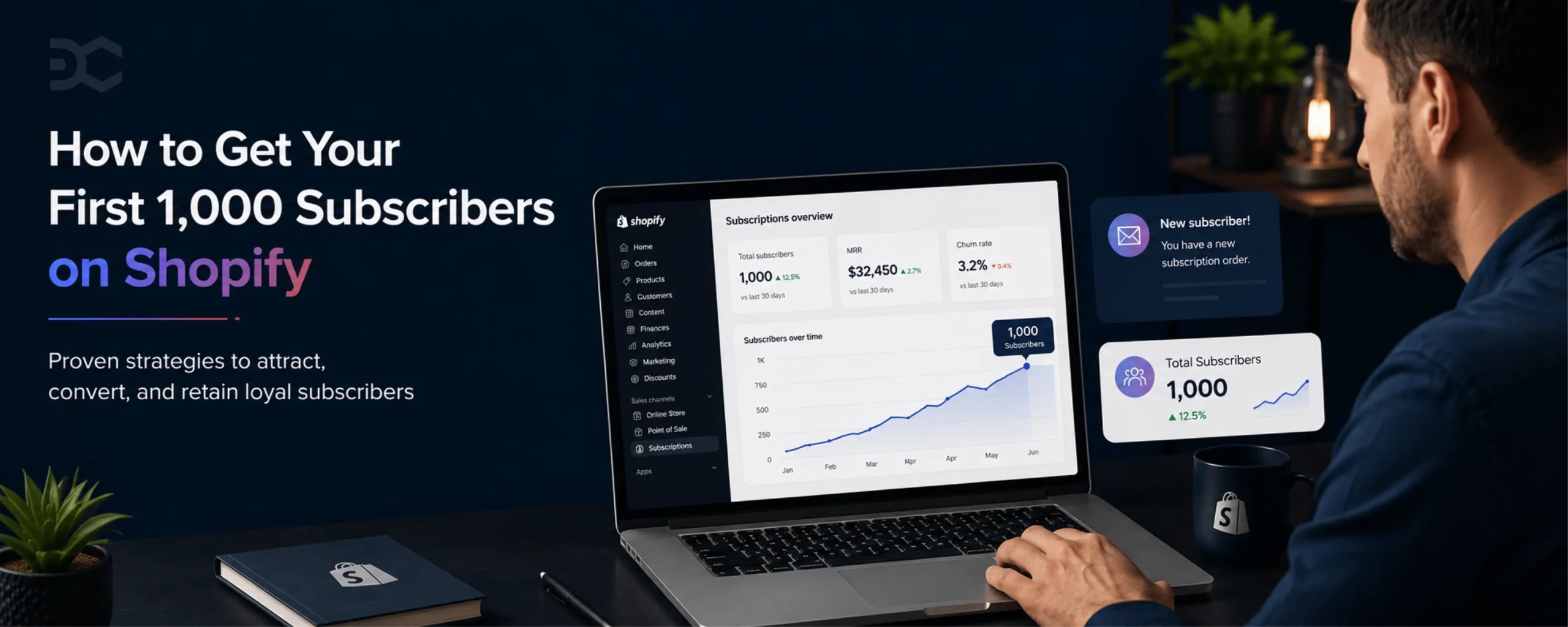
How to Get Your First 1,000 Subscribers on Shopify
- Updated: June 12, 2026
Table of Contents
You turned on subscriptions months ago, and the number has barely moved. A few signups come in, then it goes quiet. You are stuck somewhere between twenty and a couple hundred subscribers, nowhere near the thousand you had in mind.
Most people treat getting to 1,000 as a traffic problem. They spend more on ads, push more visitors to the store, and wait for the number to climb. It rarely does.
Getting to 1,000 is really about keeping the subscribers you already paid to get. Every person who cancels in month two is someone you have to win back before you actually move forward. Keep them, and the growth starts to stack.
So the real question is not how to get subscribers on Shopify. It is how to get ones who stay. That comes down to a few simple numbers, and once you see them, you know exactly where your growth is leaking.
Why getting to 1,000 Shopify subscribers is about retention, not traffic
Picture two stores that both sign up 100 new subscribers a month. One loses 3 in every 100 each month. The other loses 8. A year later the first store sits near 980 active subscribers and the second closer to 690. Same effort at the top, very different number at the bottom.
That gap is churn doing its quiet work. It never arrives as a dramatic event, so most people miss it until growth stalls and they cannot explain why.
Here is the part that catches people off guard. Once you lose a steady percentage every month, new signups stop adding to your total and start replacing the ones walking out the back. You are running hard to stay still.
So 1,000 is not a finish line you sprint toward with traffic. It is the point where the subscribers you keep outnumber the ones you lose by enough to compound. Reach it, and the number starts climbing on its own.
That single difference, retention, is what lets you grow a subscription business on Shopify without endlessly raising your ad spend. Keep more people, and you need far fewer new signups to move the total, which lowers what it costs you to get there.
What counts as an active Shopify subscriber
A subscriber only counts if they are still paying you this month. That sounds obvious, yet it is where most growth tracking quietly breaks.
There is a difference between acquired and active. Acquired is everyone who ever signed up. Active is everyone still on a paid cycle. The first number only grows. The second is the one your revenue actually runs on.
Say you signed up 400 people over the past year but 150 have since cancelled or lapsed. Your acquired count is 400. Your active count is 250. When you aim for 1,000, you mean 1,000 active, not 1,000 who passed through once.
Hold onto that split, because the rest of this comes down to active numbers. Every figure ahead, your cost to get a subscriber and what one is worth, only makes sense once you count the right way.
How long does it take to get 1,000 subscribers on Shopify?
Most Shopify stores reach 1,000 active subscribers in 12 to 24 months. The exact timing depends on how many you add each month and how many you keep, not on luck or a single viral moment.
Run the simple version. Add 80 net new subscribers a month and you cross 1,000 in around a year. Add 40 and it takes closer to two. “Net new” is the key phrase, because it already subtracts the people who cancelled.
This is where churn stretches the timeline. At 3% monthly churn you lose 30 of every 1,000, so you only need to replace 30 to hold steady. At 8% you lose 80, and a big chunk of every month’s signups goes to plugging that hole instead of growing.
Your starting traffic sets the pace too. A store with 20,000 monthly visitors and a 2% subscribe rate adds 400 signups a month before churn. A store with 3,000 visitors adds 60. Same goal, very different runway.
So the honest answer is that you control the timeline more than you think. Lift the subscribe rate, lower the churn, and 24 months turn into 12.
The math behind reaching 1,000 Shopify subscribers
Three numbers decide whether you ever reach 1,000, and none of them is your follower count. They are how many people see your offer, how many of them subscribe, and how many you keep. Get those three right and the total takes care of itself.
The formula that actually holds 1,000
Acquiring 1,000 subscribers and holding 1,000 are two different problems. You can sign up a thousand people over a year and still have 600 active, because the rest left while you were busy chasing new ones.
The shape is simple. Your active subscriber count settles where monthly signups equal monthly losses. So the real target is a signup rate that outruns your churn long enough to compound past 1,000 and stay there.
Break it into the three levers. Monthly visitors, multiplied by the percentage who subscribe, gives your new signups. Your churn rate decides how many of the existing base you lose at the same time. Net growth is the first number minus the second.
That means you have three ways to move faster, and adding traffic is only one of them. Lifting your subscribe rate or cutting your churn often costs far less and moves the total just as hard.
A worked example
Take a coffee brand selling a $32 monthly bag. It gets 10,000 visitors a month and converts 2.5% to a subscription, which is a realistic subscribe-and-save rate for a strong consumable offer. That is 250 new subscribers a month.
Now apply churn. Across subscription ecommerce, average monthly churn runs around 4% for consumer goods and retail, and replenishment products like coffee tend to sit on the lower end of that. Say this brand runs at 4%.
In month one it adds 250 and loses almost nothing, since the base is small. By the time the base reaches 1,000, a 4% loss is 40 a month, easily covered by 250 signups, so it keeps climbing well past the goal. Push churn to 10%, common for curated boxes, and at 1,000 active you lose 100 a month, eating nearly half your growth.
Where your first Shopify subscribers actually come from
Cold traffic is the most expensive way to find your first 1,000, yet it is where most people start. The cheaper subscribers are already closer than you think, sitting in your customer list and your current store visitors. Work them in order, from warmest to coldest, and you reach 1,000 for a fraction of the spend.
1. The buyers who already trust you
The person who already bought from you once is your easiest yes. They trusted you with their card, the product showed up, and nothing went wrong. That trust is the hardest part of a subscription, and you already cleared it.
The move that works: send a single email three to five days after delivery, once they have used the product, offering their next order on repeat at a small standing discount. That window, just after they have felt the value, converts far better than a cold ad or a same-day upsell.
One email rarely does it on its own. Converting repeat customers into subscribers is its own process, with onboarding, timing, and an offer that fits where the customer already is.
2. The visitors already on your site
You are already paying for the visitors landing on your product pages. Most of them leave without ever seeing that a subscription exists.
This is where your subscription conversion rate gets won or lost. Pre-select the subscribe option on the product page, sit it directly above the buy button, and show both prices side by side so the saving needs no math: $32 once, or $28 on repeat. Then repeat that same widget on your homepage and top collection pages, since every extra place a visitor can subscribe lifts the rate without costing you a new click.
3. The list you are not working hard enough
A welcome flow is one of the cheapest subscriber sources you will ever build, and most stores leave it switched off. Someone who signs up for your list but does not buy is a warm lead you can move to a subscription over a few messages.
Build a three-email sequence that teaches before it sells: email one shows how the product fits a daily routine, email two answers the cancel-anytime worry head-on, email three makes the subscribe offer. Send the same flow over SMS for anyone who opted in, where one well-timed text often beats a string of emails.
4. Letting subscribers bring subscribers
Your happiest subscribers will bring you more, but only if you ask. Set up a give-and-get referral that rewards both sides, a free month for the subscriber who refers, a first-order discount for the friend, and prompt it right after a successful delivery, when satisfaction is highest.
Social proof does the quieter work. Put real subscriber counts, reviews, and unboxing clips on the product page, since a first-timer hesitates less about a recurring charge when they can see how many people already committed.
5. Paid ads, but only after the rest
Paid ads belong last, not first, and only once the four channels above are pulling. Running cold traffic into a subscription before you know your numbers is how budgets vanish.
The reason is simple. You pay the full cost to acquire a subscriber today, but the revenue arrives slowly over months. When you do start, retarget the warm audiences first, past buyers, email non-openers, visitors who viewed a subscription product, before spending on cold prospecting. Get your cost-to-acquire and subscriber-worth figures straight first, and ads become a multiplier instead of a gamble.
What does it cost to acquire a Shopify subscriber?
Your subscriber acquisition cost is what you spend on marketing and sales in a period, divided by the number of subscribers you gained in that same period. Spend $2,000 in a month and sign up 100 subscribers, and your cost to acquire each one is $20. That single number tells you whether your growth is affordable or quietly draining you.
It goes by a few names. Some call it subscriber acquisition cost, others fold it into customer acquisition cost, the broader figure that counts every buyer, not only the ones on a recurring plan. For a subscription, the subscriber-specific version is the one that matters, because a subscriber pays you over months, not once.
That timing is the whole catch. You pay the full cost to win a subscriber today, but the money comes back slowly, one billing cycle at a time. A $20 acquisition cost looks cheap until you notice it takes that subscriber three months of payments just to cover it.
So the real question is not what a subscriber costs. It is what you can afford to spend before the cost outruns what the subscriber is worth. A coffee subscriber paying $28 a month who stays a year gives you far more room to spend than one who cancels after two.
This is also why your Shopify customer acquisition cost rarely sits still. The first subscribers from your own customer list and store traffic cost almost nothing. The cost climbs as you push into colder channels and paid ads, which is exactly why those came last in the order above.
Before you scale any channel, you need your real number, not a guess. Work out what you actually pay for each new subscriber, then hold it against what one is worth, which is where this goes next.
What a subscriber is worth, and when it’s safe to scale subscription growth
A subscriber who stays ten months is worth ten times one who quits after the first charge, yet most stores spend the same to get both. Knowing what a subscriber is actually worth is what turns acquisition from a guess into a decision.
How to calculate subscriber LTV
Lifetime value is what a subscriber pays you across their whole time on the plan. The quick formula is your average monthly revenue per subscriber, multiplied by how many months they typically stay.
Run the coffee example. A $28 monthly plan and an average stay of twelve months gives a lifetime value of $336. If churn drops and people stay sixteen months instead, that same subscriber is suddenly worth $448, without a single new signup.
That second number is the point. Your Shopify customer lifetime value moves the most when you keep people longer, not when you charge more. A small cut in churn quietly lifts the worth of every subscriber you already have.
The ratio that tells you it’s safe to scale
One number decides whether you should pour more money into growth, and it is the ratio between what a subscriber is worth and what one costs you. Lifetime value divided by acquisition cost gives you the LTV to CAC ratio.
Aim for 3 to 1. A subscriber worth $336 who costs $112 to acquire sits right at that mark, which means every dollar you spend acquiring brings back three over time. That is healthy, and it means you have room to spend more.
Below 3 to 1, scaling makes the problem bigger, not smaller. You would be buying subscribers who cost more than they return, and more ads only speed up the loss. Hit 3 to 1 or better with churn under control, and that is your signal that the growth engine is ready to take real fuel.
How subscriber churn quietly drains your growth before 1,000
You can pour subscribers into the top all year and still end up flat. If they drain out the bottom as fast as they arrive, every dollar you spent acquiring them leaks away with them.
This is why retention beats acquisition for getting to 1,000. Cutting your Shopify churn rate does not just save a few subscribers, it lifts the worth of every one you keep and lowers how many new ones you need. One number, working in your favor instead of against you.
Most of the damage happens early. People who cancel usually do it in the first cycle or two, before the product becomes a habit and before the subscription feels like something they would miss.
Two leaks cause most of it. Some subscribers actively cancel because the value faded or they piled up too much product. Others never meant to leave at all. A failed payment with no follow-up lapses the subscription quietly.
The second kind is the easier win, because that subscriber still wanted to stay. Before you spend more on acquisition, find your real churn number and where it comes from. A churn rate calculator shows you the figure and what it is costing you each month.
Your roadmap from your first 100 to 1,000 subscribers
Nobody jumps to 1,000. The stores that get there hit a few smaller marks in order, and each stage has one job that sets up the next.
Your first 100 come almost entirely from people who already know you. Convert your existing buyers and the visitors already on your store, get your onboarding tight, and watch where the early cancellations cluster. This stage is about proof, not scale.
From 100 to 500, you turn on the channels that compound. Build the welcome and win-back flows, add a referral that rewards both sides, and let social proof carry more of the convincing. Watch the first 90 days closely, because what makes subscribers cancel that early decides whether this stage builds or stalls.
From 500 to 1,000, paid acquisition finally earns its place, but only with your numbers in hand. By now you know your churn, your cost to acquire, and what a subscriber is worth, so every dollar of ad spend is a calculated bet, not a hope.
The thread running through all three is the same. A working subscription growth strategy adds new subscribers faster than it loses old ones, at every single stage. Skip the keeping, and the getting never compounds.
FAQs about getting subscribers on Shopify
How much does it cost to acquire a subscriber?
It depends on the channel, and the spread is wide. Subscribers from your existing customers or email list can cost only a few dollars, while paid ads in a competitive category can run $50 or more each. The number that matters is not the average, it is your own, measured per channel so you can see which sources are cheap and which are draining you.
What is a healthy CAC for a Shopify brand?
A healthy CAC is any number that stays well below what a subscriber is worth to you. Across DTC ecommerce, acquisition costs commonly land between $20 and $90 depending on the category, but that range means little on its own. The real test is the 3 to 1 rule: if a subscriber is worth at least three times what you paid to get them, your cost is healthy.
How do you get your first 1,000 subscribers on Shopify?
Start with the people who already trust you, then keep them. Convert your past buyers and current store visitors before spending on cold traffic, since they cost the least and subscribe the most. From there, 1,000 is less about adding signups and more about holding onto them, so a low churn rate matters as much as any acquisition channel.
How many subscribers do I need to be profitable?
There is no fixed count, because profitability is about the gap between what subscribers pay and what they cost, not the size of the list. A store can profit at 200 subscribers with strong margins and low churn, while another loses money at 2,000. Get your per-subscriber math right first, then more subscribers simply means more profit.
What is a good subscription conversion rate?
A subscribe rate of 2 to 5 percent of buyers is a reasonable target for a strong consumable offer. Beyond the benchmark, your own trend matters more: a rate climbing month over month tells you more than hitting someone else’s number once. Track it per product, since a single low-fit product can drag your whole average down.
Most stores stuck at a few hundred subscribers are watching the wrong number. They track how many people sign up and barely look at how many quietly leave.
The fix is not a bigger ad budget. It is knowing your churn, what a subscriber is worth, and what you can spend to win one. Once you have those three, you can see where the growth is actually coming from.
So before you chase another channel, find the number you have been avoiding. Work out how many subscribers you lose each month, and why they go. That answer decides whether your next thousand takes one year or three.
A subscriber who stays a year is worth far more than the ad that found them. Churn quietly empties the list before that worth is ever earned. Driftcharge is being built so that Shopify brands can reach 1,000 subscribers and hold it, instead of patching retention after the leak starts.

Ganesh Pawar

Join the waitlist now
Limited early access. Early joiners receive additional discounts on premium features.
Discover how