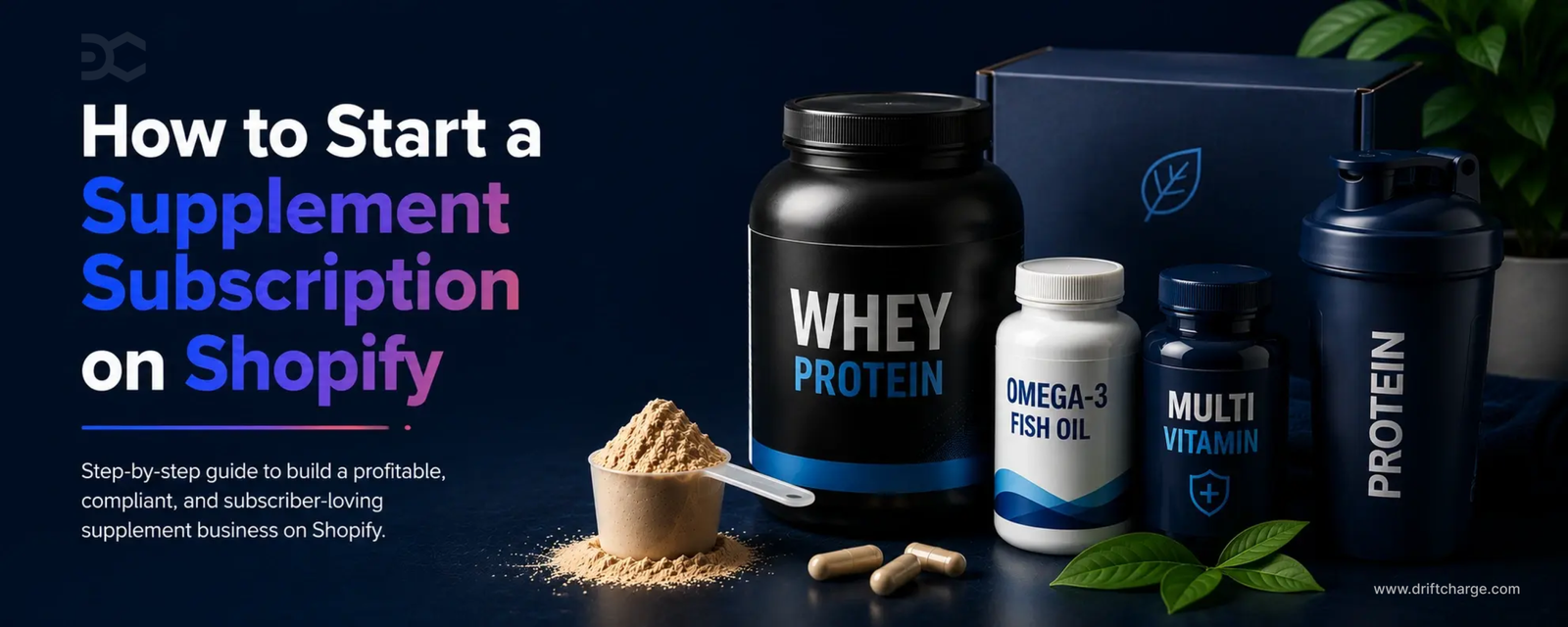
How to Start a Supplement Subscription on Shopify
- Updated: July 9, 2026
Table of Contents
Every supplement bottle comes with a built-in expiration date on when the customer runs out. That should make it the easiest subscription product in DTC.
It isn’t. Most supplement stores still lose the majority of their subscribers before month three, long before the lifetime-value math ever gets a chance to work.
If you’re figuring out how to start a supplement subscription on Shopify, the product isn’t the hard part. The hard part is everything wrapped around it: picking the right subscription model, getting the compliance details right before regulators care, choosing a payment setup that won’t freeze your payouts mid-launch, and building a cancellation flow that keeps people rather than chasing them off.
Get those four right and month three stops being where the business quietly dies.
Why supplement subscriptions are a smart bet in 2026
Roughly three in four Americans take a dietary supplement in some form. That alone puts the category among the largest consumer markets on Shopify, but scale isn’t actually the interesting part.
The interesting part shows up in the math behind a single order. Supplement brands carry some of the highest customer acquisition costs in DTC, commonly landing between $80 and $130, with a typical figure sitting around $89. Even with a healthy average order value in the $75 to $150 range, a big chunk of that first sale is gone before it ever becomes profit.
That’s the piece most new supplement brands miss. The real business isn’t the first sale, it’s the second, third, and fourth reorder, what the industry usually calls auto-ship: the bottle showing up again without the customer having to remember to buy it.
Brands that build around that reorder from day one tend to outlast the ones still selling one bottle at a time. It’s the same logic behind recurring revenue generally, applied to a product that happens to run out on a schedule.
The 4 supplement subscription models and how to pick one
Not every supplement brand should be running the same subscription. The model you pick decides how often you ship, how much you can charge, and how hard retention has to work later.
There are four real options.
Subscribe & save: single-product replenishment
It’s the lowest-commitment option in the lineup: pick a bottle, set a schedule, get a small discount for staying on it. A single bottle of magnesium or a fish oil replenished every 30 or 60 days is the classic case.
It’s also the easiest to set up and the easiest for a customer to understand, which makes it the right starting point for a brand with one or two hero SKUs rather than a full line.
Bundles and daily vitamin packs
Once a brand has more than a couple of products, bundling them into one shipment usually beats making the customer manage three separate subscriptions. Daily packs, where each day’s dose is pre-sorted, push this further: the customer isn’t just buying supplements, they’re buying not having to think about supplements.
Higher AOV, but more moving parts on the fulfillment side.
Personalized, quiz-based subscriptions
A short quiz recommends a stack based on goals, age, diet, or symptoms, and the subscription gets built around the answer. This is where a brand can genuinely out-position a tool like Appstle, which handles the subscription mechanics but has nothing to say about how the product gets chosen in the first place.
Done well, it also raises AOV, since the recommendation naturally leans toward more than one product.
Full protocol subscriptions: multi-product regimens
The deepest commitment: a multi-product regimen sold as a single ongoing plan, usually built around a specific outcome like sleep, hormone support, or recovery. Highest AOV, highest retention when it works, but it demands real expertise behind the protocol, not just a product catalog.
Should you sell single supplements or bundles? Start with what your catalog actually supports. A one-product brand forcing a full protocol model will feel hollow. A ten-SKU brand running plain subscribe & save is leaving AOV on the table. Most stores land somewhere between subscribe & save and bundles before graduating to personalization once they have the order volume to justify it.
Are supplement subscriptions profitable?
Ask this before you build anything, because the honest answer is “not on the first order,” and a lot of new brands don’t find that out until the CAC bill arrives.
Gross margins on DTC supplements typically sit in the 45–65% range, which sounds healthy until acquisition costs come out of it. Supplements carry some of the steepest CAC of any DTC category, and that cost eats a real share of what a first order would otherwise return.
This is the same squeeze from earlier: even a strong average order value doesn’t fully offset an acquisition cost that can run past $100. The business only starts working once a customer reorders.
The standard target here is a 3:1 ratio between lifetime value and acquisition cost. A customer who orders twice usually clears that bar on their own. One who orders three or four times, which is exactly what a well-run subscription is built to produce, is where the real margin shows up. Compare that to a one-time buyer, whose entire value is capped at that first sale, and the gap in subscriber lifetime value versus one-time buyer lifetime value becomes the whole argument for running subscriptions in the first place.
If you want to see where your own numbers land, run them through an LTV calculator against your current CAC.
Reorders are also where churn quietly decides this outcome for you, so it’s worth knowing your own churn rate before you commit to a subscription model at all.
Do you need a license or FDA approval to sell supplements?
There’s no such thing as an “FDA-approved” supplement. The FDA doesn’t pre-approve them, and no supplement brand can legally claim that label, no matter how the marketing reads.
What actually applies is different, and less optional than “approval” makes it sound. Your facility has to be registered with the FDA. Manufacturing has to follow cGMP under 21 CFR Part 111, covering everything from ingredient testing to recordkeeping. Labeling has to meet FDA’s specific format for dietary supplements, not just general food labeling rules.
Claims are where most new brands slip. You can say a product supports joint health. You can’t say it treats arthritis. The first is a structure/function claim, allowed with the standard disclaimer attached. The second is a disease claim, and making it turns your supplement into an unapproved drug in the FDA’s eyes.
The FTC sits alongside this too: any claim you make has to be substantiated, meaning you need real evidence behind it, not just a supplier’s marketing copy. Third-party testing and a certificate of analysis won’t satisfy every requirement here, but they go a long way toward building the kind of trust that keeps both regulators and customers off your back.
Selling outside the US adds another layer. The UK runs this through the MHRA and Food Standards Agency, while the EU works from EFSA and the Food Supplements Directive, and neither maps cleanly onto US rules.
None of this is legal advice. Confirm your specific labeling, claims, and registration status with a supplement-compliant attorney or regulatory consultant before you launch.
Can you actually use Shopify Payments for supplements?
Shopify itself allows supplement stores. Shopify Payments is the narrower risk: its policy prohibits “nutraceuticals, pseudo-pharmaceuticals and other products that make health claims that have not been approved or verified by the applicable local and/or national regulatory body,” and enforcement often lands after launch, not before.
That gap between “allowed to sell” and “allowed to get paid” is the actual landmine. Shopify Payments typically approves new accounts automatically at signup, no manual review, no red flag. The scrutiny tends to show up later, once volume and chargebacks give the underlying processor something to look at. When it does, the usual result isn’t a warning, it’s a payout freeze or account termination, sometimes with funds held in a rolling reserve for months while you’re locked out.
The claims language from the last section is exactly what drives this. A supplement marketed with careful structure/function language reads very differently to a risk system than one edging toward disease claims, and the second kind is also the one generating the most chargebacks.
The fix is a high-risk merchant account paired with a Shopify-compatible gateway, Authorize.Net and NMI are the two most commonly used, connected through your subscription app instead of running through Shopify Payments directly. It costs more per transaction. It also doesn’t disappear the day your volume spikes.
How to set up your supplement subscription on Shopify
Setup itself is the easy part. Here’s the actual sequence.
- Pick a subscription app – This decides almost everything downstream, from how flexible your billing cadence can be to whether pause/skip is built in or bolted on.
- Create your subscription product – Set it up as a subscribable product inside the app, tied to your existing inventory rather than duplicated as a separate SKU.
- Set your delivery frequency – The default guess is usually wrong. More on that below.
- Configure the customer portal – This is where subscribers manage, pause, skip, or swap their own orders, and a clunky portal quietly drives cancellations before anyone hits “cancel.”
- Connect your payment gateway – If you read the last section, you already know this may need to be a high-risk gateway routed through your subscription app rather than Shopify Payments directly.
That’s the whole path. Two of these steps have a supplement-specific trap worth its own attention.
Match delivery frequency to how fast the bottle runs out
A 60-day bottle shipped every 30 days doesn’t feel generous, it feels wasteful. Customers end up with a shelf of unopened product, and a stockpiled customer is a customer who cancels, not one who reorders.
Set the default cadence to match your actual dosage math, then let customers adjust it themselves in the portal rather than guessing for them.
Single-product vs. bundle subscriptions
One of these is simple. The other isn’t, and pretending it is causes fulfillment headaches later. A single-product subscription is just a recurring line item. A bundle needs its own configuration, one that lets each component ship on its own schedule, since they usually run out at different rates.
Inventory, lot tracking, and expiry dates
This is the piece most setup guides skip entirely. Supplements carry lot numbers and expiration dates, and a subscription running for a year or more means your fulfillment has to track which lot shipped to which customer, not just how many units are in stock.
Get this wrong and a single recall turns into a manual audit of every order you’ve shipped, that’s not the day you want to discover you weren’t tracking lots.
How to price a supplement subscription
Start from the number your customer already knows: the one-time retail price of the bottle. That’s the anchor everything else gets compared against.
From there, the subscribe & save discount is usually somewhere between 10% and 20% off that price. Go lower and it doesn’t feel worth committing to. Go much higher and you’re eating margin you already calculated was thin in the first place.
An annual or prepaid plan is worth offering alongside the standard monthly cadence, even if most customers don’t take it. The ones who do pay upfront, which improves cash flow immediately, and they’ve already made the decision that usually causes churn, so they tend to stick around far longer than month-to-month subscribers.
Whatever discount you land on, it should come out of the margin math from earlier, not a round number that sounds fair on its own.
Staying compliant with auto-renewal and “click-to-cancel” laws
The federal click-to-cancel rule that would have forced every subscription business to make canceling as easy as signing up got vacated by an appeals court in July 2025. That sounds like the pressure is off. It isn’t.
The court’s objection was procedural, not a rejection of the rule’s substance, and the FTC responded in March 2026 by opening a new rulemaking process aimed at bringing much of it back. Comments closed in April. A final rule is still likely years away, but the direction is clear.
In the meantime, ROSCA already covers most of the same ground at the federal level: clear disclosure before you bill anyone, express consent to the charge, and a simple way to stop it. That law never went anywhere, vacatur or not.
Roughly 30 states layer their own automatic renewal laws on top of this, and California’s is the strictest, requiring renewal reminders and regulating how you’re allowed to handle a customer trying to cancel. Enforcement has been active, and subscription supplements have historically drawn more of that attention than most categories.
None of this needs to feel like a compliance burden bolted onto the business. Cancel-as-easy-as-signup, transparent renewal terms, and offering a pause instead of forcing a full cancel aren’t just what regulators want, they’re also what keeps a subscriber from leaving in the first place.
This isn’t legal advice. Confirm your cancellation flow and renewal disclosures against ROSCA and your specific state’s requirements with an attorney before launch.
How to keep supplement subscribers past month 3
Most subscription churn isn’t a customer changing their mind. It’s a card that got declined, a bottle that showed up before the last one ran out, or a cancel button that was easier to find than a pause button.
Fix those three things and you avoid the drop-off most stores see in the first 90 days.
Pause and skip beat cancel
A customer who cancels is gone. A customer who pauses for a month is still yours. The difference is entirely about which option you make easier to find, and most subscription setups still bury pause behind cancel instead of putting it first.
This is also the compliant way to run a save-offer: when someone starts the cancellation flow, offering a pause or a skip before they finish is legitimate retention. Trying to talk them out of canceling with pressure tactics or hidden steps is the kind of thing that draws the regulatory attention covered earlier.
Recover failed payments automatically
Supplement subscriptions run on high-risk cards more often than most categories, and high-risk cards decline more often too. A lot of what looks like a customer choosing to leave is actually a payment that just failed silently, what’s usually called involuntary churn.
Automated dunning, retrying the card, emailing the customer, retrying again on a delay, recovers a meaningful share of these before they ever become a real cancellation.
The other two levers are ones already covered: annual and prepaid plans reduce how often a customer has to make the cancel decision at all, and getting delivery cadence right so bottles don’t pile up removes one of the most common reasons someone cancels in the first place.
Run the numbers on where you’re actually losing people, a churn calculator makes the weak point obvious fast, whether that’s payment failures, cadence mismatch, or something in the portal itself. Once you can see where subscribers are actually dropping off, the case for retention tooling built specifically for this stops being theoretical.
Choosing the best subscription app for supplements
For a supplement brand specifically, four things matter more than they do for a typical subscription store: failed-payment recovery, how visible pause and skip are to the customer, how usable the self-serve portal actually is, and whether the app plays well with a high-risk gateway instead of assuming you’re on Shopify Payments.
Here’s an honest look at where the main options stand.
Shopify Subscriptions — it’s native and free, a reasonable place to start, but its dunning is genuinely basic: fixed retry schedule, limited email customization, no decline-specific logic. Most brands outgrow it once volume picks up.
Recharge — this has been the long-standing default, and it got bigger in April 2026 when it acquired Skio, consolidating two of the category’s biggest names into one. Broad features, wide app-ecosystem support, but it can feel like more infrastructure than a smaller brand needs.
Loop — it’s built its reputation specifically around payment recovery and cancellation-flow customization, with retry logic that goes deeper than most competitors and backup-card auto-retry before dunning even starts. Worth a close look given the pause-vs-cancel problem from the last section.
Appstle — it’s fast to set up and strong on quiz-based personalization and bundling, and it does support Authorize.net alongside Shopify Payments, so the high-risk-gateway gap I’d normally flag here isn’t really there.
Bold — this one has real depth: up to 15 payment retry attempts, Authorize.net support, and Shopify Plus certification for stores running real volume. It’s been around long enough that migration tools from nearly every competitor are mature.
Driftcharge — it’s built with the dunning-and-compliance side specifically in mind, worth a look if that’s where your current setup is thinnest.
None of these is universally right. The one that fits is whichever is strongest exactly where your setup is weakest.
How to market and launch your supplement subscription
A quiz funnel does double duty here: it recommends the right product, and it gives you first-party data on exactly who’s buying, which is worth more than another ad platform right now.
Education-led content, explaining what an ingredient actually does instead of just listing it, tends to outperform straight product marketing in this category. Supplement buyers are more skeptical than most, and a brand that explains itself earns trust faster than one that just claims results.
That skepticism is also why trust signals matter more here than in most niches. A certificate of analysis, a third-party testing badge, a visible GMP claim, these aren’t decoration. They’re often the deciding factor between two nearly identical products.
None of this converts a subscriber on the first order, though. Turning that first-time buyer into a subscriber happens in the days after, through an email flow timed to land right as the bottle’s about to run out.
Common questions about starting a supplement subscription
Does Shopify allow supplements?
Yes, Shopify itself allows supplement stores. The narrower issue is Shopify Payments, which prohibits products making health claims not verified by a regulatory body, sometimes called “pseudo-pharmaceuticals.” Most supplement brands stay compliant by watching their claims language closely, or by routing payments through a high-risk gateway instead.
Can you run subscriptions through Shopify?
Yes, through either Shopify’s native Subscriptions feature or a third-party app like Recharge, Loop, Appstle, or Bold. Native Shopify Subscriptions is free but limited on dunning and portal customization. Third-party apps cost more but typically offer deeper retention tools, better suited to a supplement brand’s higher decline rates.
Do you need a license or FDA approval to sell supplements?
There’s no such thing as FDA approval for supplements. What you do need is facility registration, cGMP compliance under 21 CFR Part 111, and compliant labeling. Claims have to stay in structure/function territory (“supports joint health”) rather than disease-claim territory. This isn’t legal advice, confirm specifics with a professional.
Are supplement subscriptions profitable?
Not on the first order, usually. DTC gross margins run roughly 45–65%, but CAC often eats most of a first order’s value. Profitability shows up once a customer reorders two or three times, which is the entire argument for running a subscription instead of one-off sales.
Should I sell single supplements or bundles?
It depends on your catalog size. A one or two-product brand should start with simple subscribe & save. A broader catalog can support bundles or daily packs, which raise AOV but add fulfillment complexity. Personalization is worth adding once you have order volume to justify it.
Setting up a supplement subscription on Shopify takes an afternoon. Picking a model, connecting a compliant gateway, getting the cadence right, none of that is where brands actually struggle.
Month three is where they struggle. A declined card that never gets recovered. A cancel button that’s easier to find than the pause option. A bottle showing up before the last one’s even empty.
Fix the setup and you’ve got a store. The subscribers who stick around past month three are the ones who decide if it’s actually a business.
Bottles run out on a schedule, cards get declined more than they should, and most supplement subscriptions quietly bleed subscribers right around month three. Driftcharge is being built so Shopify supplement brands can catch that before it happens, not clean it up after.

Ganesh Pawar


Join the waitlist now
Limited early access. Early joiners receive additional discounts on premium features.
Discover how


You may also like

October 22, 2025
Shopify Q4 Sales 2026: Strategy & Apps for BFCM and Holidays