Shopify Subscriber LTV vs One-Time Buyer LTV with Real Benchmarks and Formulas
- Updated: June 3, 2026
Table of Contents
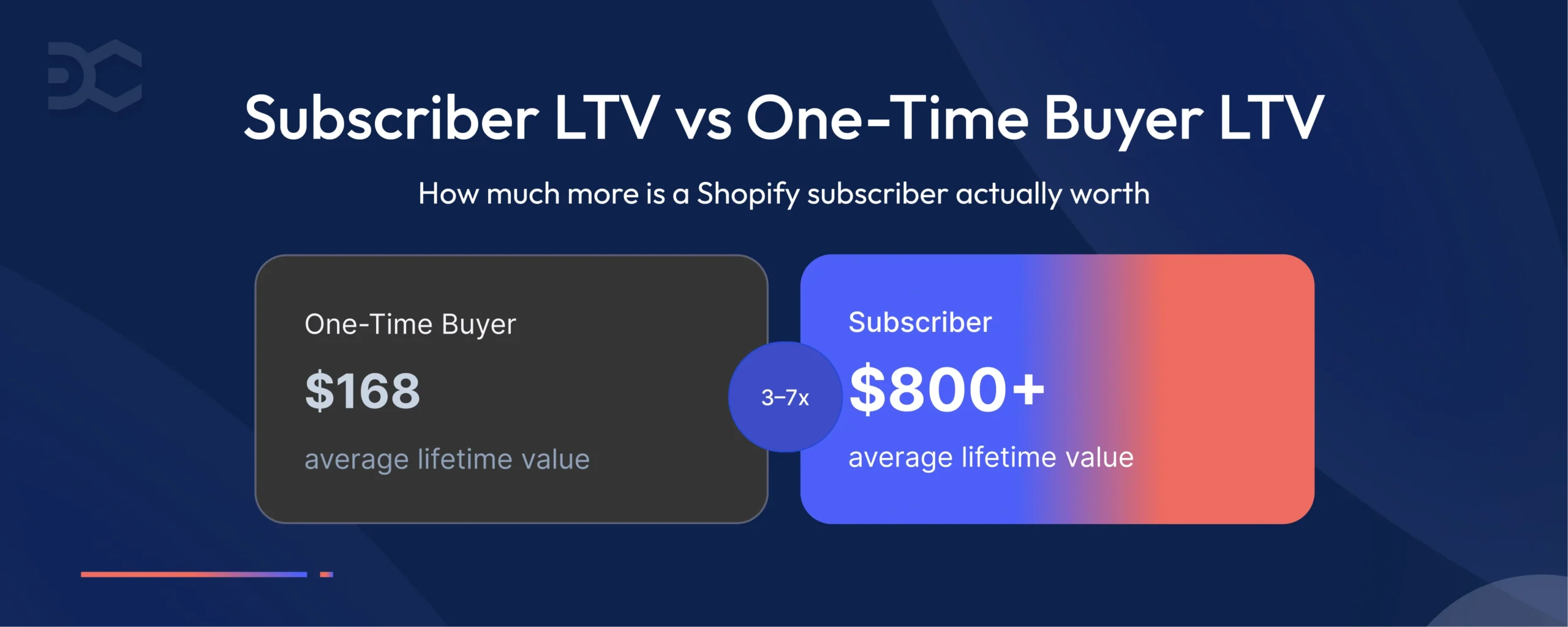
Shopify stores running active subscriptions see customer lifetime values between $350 and $800. The average Shopify customer lifetime value for one-time buyers on the same platform sits at $168. That is not a small gap. Retained customers generate ten times more lifetime value than one-time buyers over their entire relationship with a brand.
Subscribers pay on a recurring schedule. One-time buyers pay once and may never purchase again. The difference in purchase frequency is what drives the entire LTV gap between these two customer types.
The size of that gap also varies significantly by what you sell. A coffee subscription brand sees a different multiplier than a supplement or pet food store. Your niche, your product, and your churn rate all shape your specific number.
You will see real benchmarks across six Shopify niches, the exact formulas to calculate subscriber LTV and one-time buyer LTV, a churn impact table showing what a 1% difference in churn actually costs, and 3 practical levers to close the gap.
Why Subscriber LTV and One-Time Buyer LTV Are Structurally Different
The gap between subscriber LTV and one-time buyer LTV is not random. It comes down to three structural differences in how each customer type generates revenue. Once you see them, the math becomes obvious.
The 3 structural reasons the gap exists
A subscriber and a one-time buyer can purchase the exact same $50 product. Twelve months later their value to your store looks nothing alike.
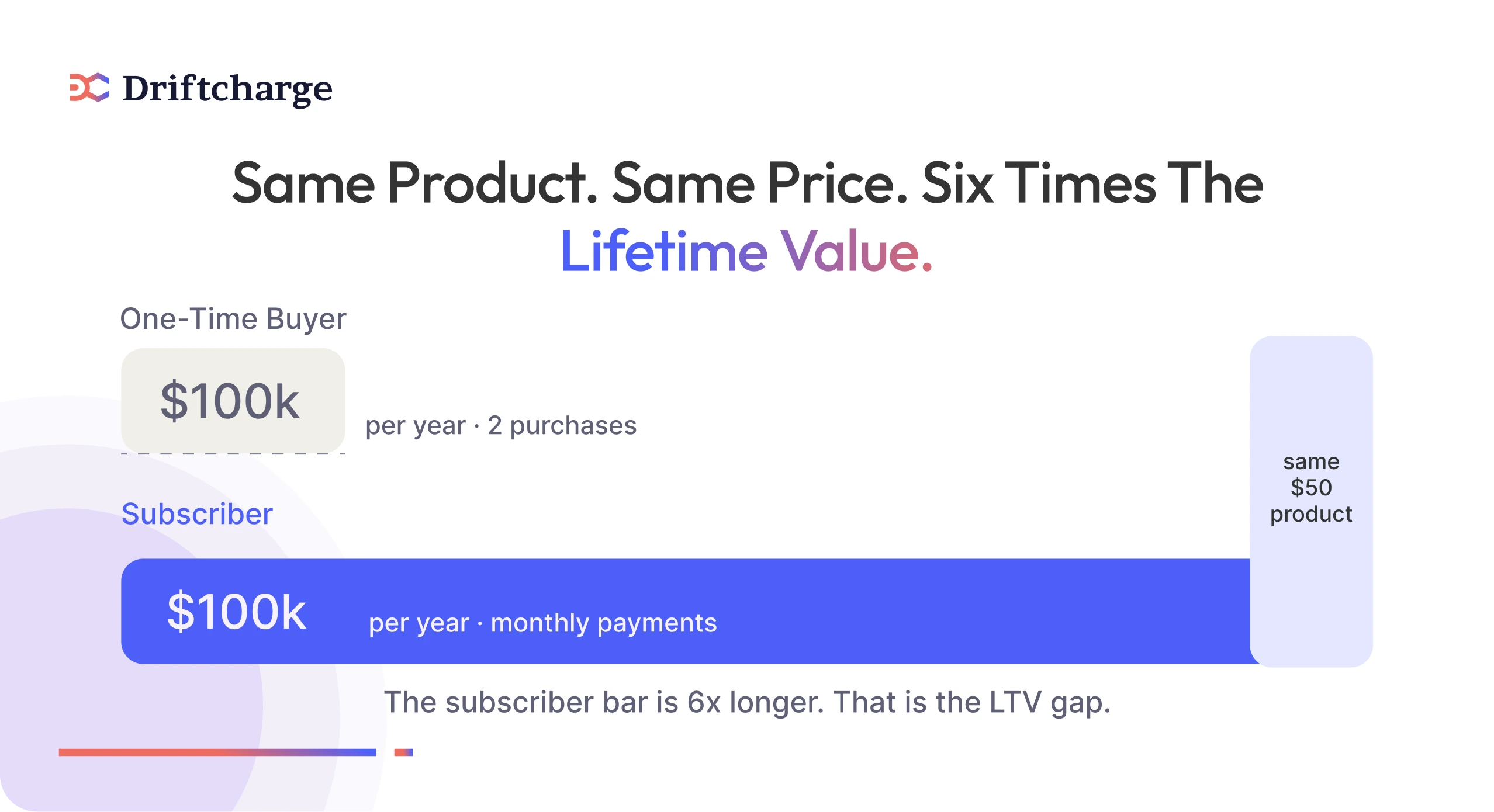
1. Purchase frequency – A one-time buyer purchases when they feel ready. That might be twice a year, maybe once. A subscriber pays every month without making that decision again. Take a $50 product as a concrete example. A one-time buyer purchasing twice a year generates $100 in annual revenue. The same customer on a monthly subscription generates $600. Same product, same price, same acquisition cost. Six times the lifetime value.
2. Revenue predictability – Recurring revenue is predictable in a way one-time purchase revenue never is. You can forecast what your subscriber base will generate next month. You cannot do the same for customers who buy on impulse or occasion.
3. CAC payback speed – If you spent $40 acquiring a customer, a one-time buyer generating $100 a year covers that cost in five months. The same subscriber generating $600 a year covers it in under a month. That difference compounds every time you scale your ad spend.
Why blended LTV hides the truth
Most Shopify stores calculate one blended LTV number across their entire customer base. That number averages subscribers and one-time buyers together and produces a figure that accurately represents neither group.
If 20% of your customers are subscribers generating $600 in annual value and 80% are one-time buyers generating $100, your blended LTV looks like $180. You make acquisition and retention decisions based on a number that does not reflect how either segment actually behaves.
Separating the two is not just an analytics exercise. It changes where you spend, who you target, and how you measure success.
Shopify Subscriber LTV vs One-Time Buyer LTV Real Benchmarks by Niche
Across Shopify stores, subscribers consistently generate 3 to 7 times more lifetime value than one-time buyers. The exact multiplier depends on your niche, your pricing, and your churn rate. What changes by niche is how large that gap gets and why.
Subscribers generate 3 to 7 times more lifetime value than one-time buyers
The $350 to $800+ subscriber LTV range cited across the Recharge State of Subscriptions 2024 report, Lifetimely’s DTC Mega Report, and Luca’s Shopify benchmarks reflects one consistent finding. Subscribers buy more, stay longer, and cost less to retain than one-time buyers across every product category studied.
The multiplier shifts depending on what you sell.
| Niche | Replenishment Cycle | Subscriber LTV Multiplier | What drives the gap |
|---|---|---|---|
| Supplements | 30 days | 4–6x | Daily consumption habit, health commitment |
| Coffee | 14–30 days | 4–6x | Ritual product, high frequency, low cancellation intent |
| Pet Food | 30 days | 4–5x | Necessity purchase, guilt-driven retention |
| Skincare | 30–60 days | 3–5x | Routine dependency, results take time |
| Beauty | 30–60 days | 3–5x | Emotional loyalty, discovery element |
| Food and Meal Kits | 7–14 days | 3–4x | High convenience value, higher churn risk |
| Apparel | 30–90 days | 2.5–4x | Lower replenishment need, style fatigue risk |
Multiplier ranges based on Recharge State of Subscriptions 2024, Lifetimely DTC Benchmark Report, and Luca Shopify LTV data. Your store’s multiplier will vary based on pricing, churn rate, and product category.
What drives the LTV gap across different niches
The niches with the highest multipliers share one trait. The product is consumed on a fixed cycle and the subscriber does not have to think about reordering. Supplements, coffee, and pet food sit at the top because running out has a consequence. The subscriber stays because the alternative, running out, feels worse than the cost of staying.
Skincare and beauty follow closely because results take time. A subscriber cancelling a skincare routine at week three never sees the outcome the product was working toward. That psychological investment keeps retention high and LTV strong.
Food and meal kits present a different challenge. The convenience value is high but so is the mental load of receiving a box every week. Churn risk is higher, which compresses the multiplier despite strong initial purchase frequency.
Apparel sits at the lower end because style fatigue sets in. A subscriber who loved their first two boxes may feel less excited by box five. The replenishment need is genuine but the emotional pull weakens over time without strong curation and personalisation.
How to Calculate Subscriber LTV and One-Time Buyer LTV in Your Shopify Store
Knowing the multiplier is one thing. Knowing your specific number is what actually changes how you run your store. These two formulas give you both figures so you can see the gap in your own numbers.
One-time buyer LTV formula
The one-time buyer LTV formula uses three inputs you already have in your Shopify dashboard.
LTV = AOV × Purchase Frequency × Customer Lifespan
AOV is your average order value. Purchase frequency is how many times a customer buys per year. Customer lifespan is how many years they stay active before going dormant.
Here is what that looks like with real numbers. Your store has an AOV of $50, customers purchase twice a year on average, and they stay active for two years.
$50 × 2 × 2 = $200 one-time buyer LTV
Subscriber LTV formula
Subscriber LTV works differently because the revenue is recurring. The formula accounts for your monthly revenue per subscriber, how quickly you lose subscribers, and your margin.
LTV = ARPU ÷ Monthly Churn Rate × Gross Margin
ARPU is your average monthly recurring revenue per subscriber. Monthly churn rate is the percentage of subscribers who cancel each month.
Using the same store with a $50 monthly subscription, 5% monthly churn, and 60% gross margin:
$50 ÷ 0.05 × 0.60 = $600 subscriber LTV
Side-by-side comparison with the same store
| One-Time Buyer | Subscriber | |
|---|---|---|
| AOV / ARPU | $50 | $50 |
| Purchase Frequency / Churn | 2x per year | 5% monthly churn |
| Customer Lifespan / Gross Margin | 2 years | 60% |
| LTV | $200 | $600 |
Same product. Same price. Three times the lifetime value just from the subscription model.
Your numbers will look different depending on your churn rate, gross margin, and how often one-time buyers return. Plug your own figures into the free LTV Calculator to see your actual gap.
How Churn Rate Silently Destroys Subscriber LTV
Most Shopify subscription stores focus on acquiring subscribers. The ones that build real LTV focus on keeping them. A 1% difference in monthly churn rate does not feel significant until you see what it actually costs.
The churn impact table — what a 1% difference actually costs
The table below uses a $50 monthly AOV to show how churn rate affects average subscriber lifespan and the lifetime value that comes with it.
| Monthly Churn Rate | Avg Subscriber Lifespan | LTV at $50/mo AOV |
|---|---|---|
| 2% | 50 months | $2,500 |
| 4% | 25 months | $1,250 |
| 6% | 17 months | $850 |
| 8% | 13 months | $650 |
| 10% | 10 months | $500 |
Lifespan calculated as 1 ÷ churn rate. LTV calculated as lifespan × $50 monthly AOV.
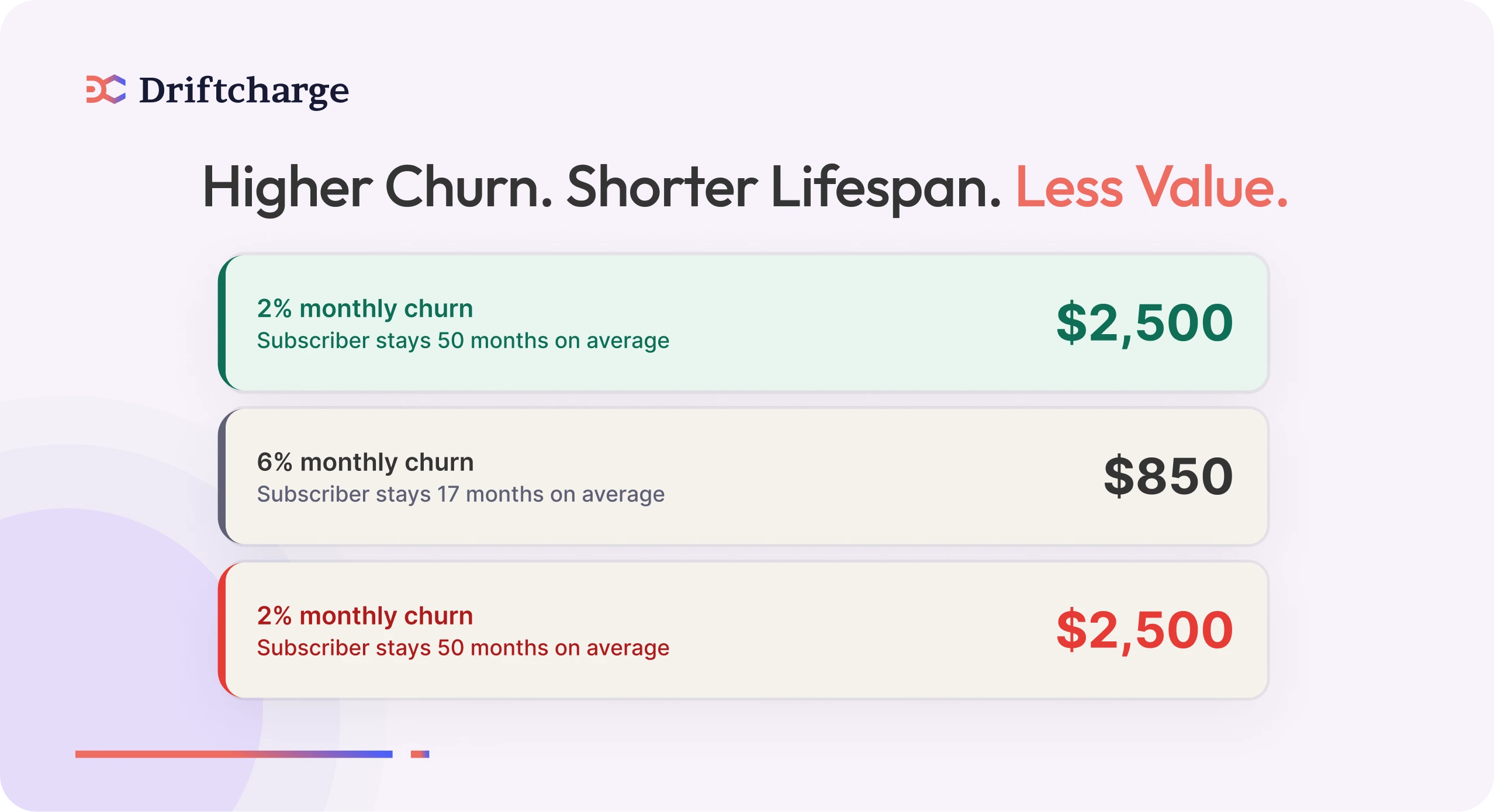
The difference between 2% and 10% monthly churn is not a minor variation. It is $2,000 in lost lifetime value per subscriber.
Why churn compounds — it is not one lost order
When a subscriber cancels you do not lose one order. You lose every order that a subscriber would have placed for the rest of their active lifespan.
A subscriber at 2% monthly churn stays for 50 months on average. Losing that subscriber in month three does not cost you $50. It costs you the remaining 47 months of revenue they would have generated.
That is why reducing churn has a compounding effect on LTV that no acquisition campaign can replicate. You are not just saving one payment. You are recovering an entire future revenue stream.
A 5% improvement in subscriber retention can increase profits by 25 to 95%. That is the compounding effect of customer loyalty economics playing out in real numbers.
The CAC payback connection
Churn rate also determines how quickly your acquisition cost pays off. At 3% monthly churn your average subscriber stays 33 months. At 6% they stay 17 months. Same CAC, same product, same price. Half the time to recover your acquisition investment and half the LTV at the end of it.
Understanding why your subscribers cancel in the first place is where this work starts. The first 90 days of a subscription are where most churn happens and where the biggest LTV gains are waiting.
Your churn rate determines more about your LTV than almost any other metric. Run your numbers through the free Churn Rate Calculator to see the exact cost to your store.
3 Levers to Improve Subscriber LTV in Your Shopify Store
The benchmark data and the churn table show you the size of the opportunity. These three levers are what you actually do about it. None of them require more ad spend or more subscribers. They work on the customers you already have.
Lever 1 — Fix involuntary churn first
Involuntary churn is the LTV killer most stores ignore. A subscriber does not decide to leave. Their payment fails, the retry does not work, and the subscription cancels without them ever making a conscious choice to stop.
Nearly half of all subscription cancellations come from failed payments, not from subscribers choosing to leave. Automated dunning is smart payment retry logic that attempts failed charges at optimised intervals. Well-run dunning sequences recover 40 to 70% of those charges before they become cancellations.
Not running automated retry sequences is one of the most common subscription mistakes Shopify stores make. If your store is not catching failed payments automatically you are losing LTV that was never actually at risk.
Lever 2 — Offer pause instead of cancel
When a subscriber hits a moment of doubt, too much product, financial pressure, or going on holiday, the only option most stores give them is to cancel. That is the wrong choice to force.
70 to 85% of subscribers who pause successfully reactivate. The reactivation rate for cancelled subscribers sits at 15 to 25%. Pause keeps the relationship alive. Cancellation ends it. A pause option gives them an exit that keeps the relationship intact. The subscriber keeps their account, their preferences, and their history. You keep the LTV.
Lever 3 — Track subscriber LTV and one-time LTV separately
If you measure one blended LTV number across your entire customer base you are making decisions based on data that accurately represents neither group. Subscribers and one-time buyers behave differently, spend differently, and respond to retention efforts differently.
Segment your LTV tracking from day one. When you can see exactly what each group generates you spend your retention budget where it produces the highest return. That is not an analytics preference. It is the difference between growing LTV intentionally and hoping it improves.
The Gap Will Not Close on Its Own
The LTV gap between subscribers and one-time buyers is real, it is measurable, and it is sitting in your data right now. The benchmarks, the formulas, and the three levers above exist because the gap does not close on its own.
Stores that start tracking both LTVs separately make better decisions about where to spend, who to target, and how to retain. That is where sustainable subscription growth actually comes from.
A subscriber generating $600 in lifetime value costs the same to acquire as a one-time buyer generating $200. Are you tracking the difference in your store? Driftcharge gives Shopify subscription brands real-time LTV analytics, built-in churn prevention, and flexible subscriber management, so you always know exactly where your revenue is coming from.

Ganesh Pawar


Join the waitlist now
Limited early access. Early joiners receive additional discounts on premium features.
Discover how