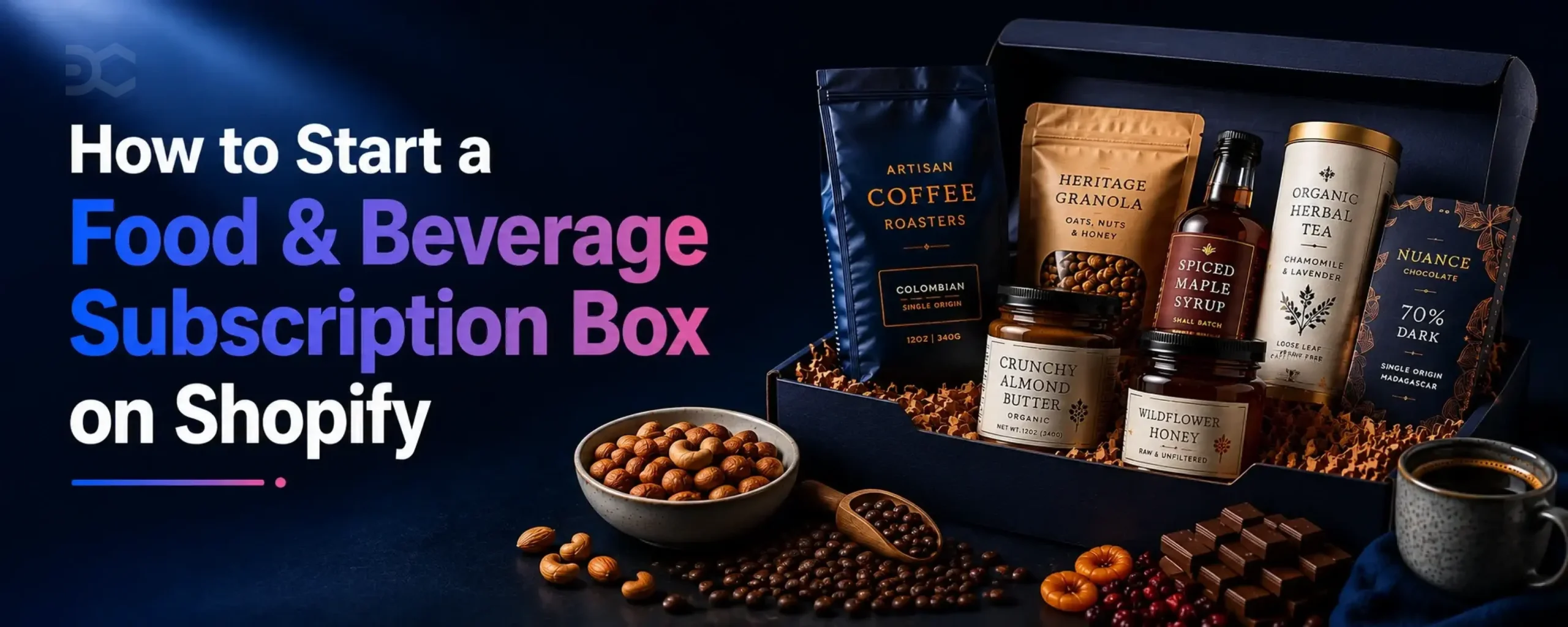
How to Start a Food & Beverage Subscription Box on Shopify
- Updated: July 27, 2026
Table of Contents
Most founders who decide to start a food and beverage subscription box on Shopify treat it as one decision. Pick a product, install a subscription app, set a price, launch. What they are actually making is three separate business decisions that happen to share a checkout page.
A replenishment subscription is a logistics business. A weekly meal kit is a demand-planning business. A curated discovery box is a curation and storytelling business. Each one has different pricing logic, different fulfillment requirements, and a completely different churn profile. Conflating them at the start is how founders end up with a subscription model that does not fit what they actually sell.
That mismatch shows up fast. Overstock complaints from subscribers getting product they have not finished yet. Cancellations after month two from customers who got bored of the same rotating selection. Margin problems because the pricing was built for one model but the operations are running another.
This is not a guide that walks you through every technical step of building a Shopify subscription box business. The Shopify setup mechanics are covered elsewhere. What this covers is the decision layer that comes before the build: which model fits your product, how to price it correctly, what compliance requirements apply before you ship a single box, and why food and beverage subscribers cancel when they do.
Get the model right first. Everything else follows from that.
Why Food & Beverage Is One of the Strongest Subscription Categories
Not every product belongs in a subscription. The ones that do share a common trait: customers will need them again whether they remember to reorder or not. Food and beverage sits at the top of that list.
The five criteria for a subscription-shaped product come down to consumability, repurchase intent, predictable timing, low switching cost, and habitual use. Food and beverage hits all five. A bag of coffee runs out. A snack selection gets eaten. A meal kit gets cooked. The product does not sit on a shelf collecting dust. It gets used, and when it does, the customer needs more.
That consumption loop is what makes this category so compelling for subscription operators. You are not convincing someone to reorder. You are automating a behavior they were already going to repeat.
Analyst estimates for this category vary depending on how the market is defined, but the direction is consistent across all of them. Fact.MR values the food subscription box market at $6.2 billion in 2025, rising to $6.7 billion in 2026 and a projected $17.3 billion by 2036. That is compound growth just under 10% a year. Separate research consistently places food and beverage as the largest single category inside the broader subscription box market, ahead of beauty, apparel, and pet. The growth is not speculative. It is being driven by something structural: consumers increasingly want the products they use regularly to arrive without friction.
DTC operators who recognize this early have a real advantage. Subscription removes the reorder decision entirely. Instead of hoping a customer comes back, you have already scheduled the next shipment. That shift from passive to predictable revenue is what separates food and beverage subscription brands from stores that sell food and beverage products.
The margin opportunity compounds on top of that. Once a subscriber is active, your cost to serve them is fulfillment and product. You have already spent the acquisition budget. Every renewal after the first order is incrementally more profitable than the one before it.
Here is what most articles on this topic skip: food and beverage is not one subscription business. It is three, each with different pricing logic, different churn behavior, and different operational requirements. A coffee replenishment store and a weekly meal kit and a curated snack discovery box all live under the same category label. They are built, priced, and retained in completely different ways.
The next section breaks down exactly what those three models are and how they work.
The 3 Models Inside Food & Beverage
The phrase “food subscription box” gets used as if it describes one thing. It describes three. Each one operates on different timing, different customer psychology, and a different relationship with churn. Picking the wrong one for your product does not just create operational headaches. It creates a business that fights itself every month.
Here is how each model actually works.
Replenishment Subscriptions
The customer buys the same product on a recurring schedule. A bag of coffee every two weeks. A case of sparkling water every month. A protein bar variety pack every 30 days. The product does not change. The delivery date does not shift. The customer is automating a reorder they would have made anyway.
Churn in this model is driven by one thing: product stacking. When delivery frequency does not match consumption rate, product accumulates. The customer feels no urgency to use it, loses the habit loop that justified the subscription, and cancels.
This is the lowest-friction model to build and the easiest to test. If you already sell a consumable food or beverage product with a predictable use cycle, replenishment is likely your entry point. Coffee is the clearest version of this. Roast dates, grind preference and a two week reorder cycle shape the entire setup, so if that is what you sell you can skip the rest of this decision entirely.
Weekly-Cutoff Kit Subscriptions
The customer subscribes to a recurring delivery of fresh ingredients or prepared components with a hard weekly cutoff. They select their meals or preferences before a deadline. The order is assembled and shipped on a fixed schedule.
This is a demand-planning business more than a subscription business. You need to know what is being ordered before you can source, prep, and fulfill it. HelloFresh and Blue Apron built this model at scale. On Shopify, it requires more operational infrastructure than a standard subscription app provides out of the box.
Churn here is driven by logistics friction. Missed cutoffs, skipped weeks that feel complicated, and delivery windows that do not match the customer’s schedule all accelerate cancellation. The weekly commitment is also higher than any other model. The customer has to engage every week, not just receive a delivery passively.
If meal kits are your product, the harder problem is forecasting demand and locking a menu before the weekly cutoff, and everything else follows from solving that.
Curated and Discovery Box Subscriptions
The customer subscribes to receive a rotating selection of products they did not choose themselves. A snack box with eight to twelve items from different brands each month. A specialty beverage box featuring small-batch producers. A regional food discovery box curated around a theme.
The appeal is not replenishment. It is the experience of discovery. The customer is paying for curation, surprise, and access to products they would not have found on their own. That is a fundamentally different value proposition than the other two models, and it requires a fundamentally different retention strategy.
Churn here is driven by novelty fatigue. When the discovery feeling wears off, usually around month three or four, cancellation intent spikes. The brands that hold subscribers past that window do it through community, storytelling, and the consistent feeling that the curation is getting better, not repeating itself.
This is where the snack box vs meal kit subscription distinction matters most. A snack box is a curated discovery product. A meal kit is a weekly-cutoff operational product. They share a checkout flow but almost nothing else.
Choosing the right subscription box business model before you build is the decision this entire post is built around.
Here is how the three models compare across the factors that actually decide which one fits your product.
| Replenishment | Weekly-Cutoff Kit | Curated / Discovery Box | |
|---|---|---|---|
| How it works | Same product ships on a fixed schedule | Customer selects from a rotating menu before a weekly cutoff | Curated rotating selection ships monthly |
| Real examples | Coffee, sparkling water, protein bars | Meal kits, fresh ingredient boxes | Snack boxes, specialty beverage boxes, regional food boxes |
| Typical churn driver | Product stacking from mismatched cadence | Logistics friction and weekly commitment fatigue | Novelty fatigue after month 3 or 4 |
| Margin profile | Strongest, lowest per-order variable cost | Thinner, high sourcing and fulfillment complexity | Moderate, curation and packaging cost varies |
| Operational complexity | Low | High | Medium |
| Best for | Brands with one consumable hero product | Operators with fresh supply chain infrastructure | Brands built around discovery, curation, or gifting |
Which Model Fits What You’re Selling
Most founders spend weeks researching subscription apps before they have answered the question that actually determines their setup, their pricing, and their retention strategy. The model question comes first. Everything else is implementation.
Three questions decide it.
Is it the same product every cycle or a rotating mix?
If your customer receives the same SKU or SKU combination every delivery, you are running a replenishment subscription. The product does not change. The schedule does. If your customer receives a different selection each cycle, chosen by you or by them, you are running a curated or kit model. That distinction alone eliminates one of the three options for most operators before they even think about pricing.
Is there a hard weekly cutoff or flexible timing?
Replenishment and curated boxes run on flexible timing. The customer picks a frequency and receives their delivery on that schedule. Weekly-cutoff kits run on a fixed operational calendar. Orders must be placed before a cutoff. Fulfillment runs on a set day. The supply chain is built around that rhythm. If your product requires fresh sourcing or prep before each shipment, you are in weekly-cutoff territory regardless of what you call it.
Is the appeal habit or discovery?
A customer who subscribes to their morning coffee is buying convenience and consistency. They want the same thing, reliably, without having to think about it. A customer who subscribes to a snack box is buying the experience of opening something they did not choose themselves. That difference in customer psychology is the curated box vs replenishment subscription divide. It determines your retention strategy, your cancellation flow, and how you write every email in your post-purchase sequence.
Run through those three questions honestly and the model usually selects itself.
What if you already run a food or beverage business?
For operators adding subscription to an existing catalog, the model is often already decided by what you sell. A coffee roaster adding a subscription is almost certainly building a replenishment model. A specialty food retailer with a rotating seasonal inventory is a natural fit for a curated discovery box. A meal prep operator with a weekly production schedule slots into the weekly-cutoff kit model by default.
The mistake this group makes is not picking the wrong model. It is trying to retrofit subscription logic onto an existing operational structure that was not built for it. If your fulfillment runs on a weekly production cycle, a flexible monthly replenishment model will create warehouse chaos. If your product line changes seasonally, a fixed replenishment subscription will leave you locked into SKUs you can no longer source.
Match the subscription model to how your operations already run, not to how you wish they ran.
On the food subscription box vs meal kit question specifically: they are not interchangeable terms. A meal kit is a weekly-cutoff operational product that requires fresh sourcing, a fixed calendar, and active weekly engagement from the customer. A food subscription box is a broader term that covers replenishment and curated models with flexible timing. Conflating the two creates positioning confusion that makes it harder to acquire the right subscriber and retain them past month three.
Is a snack box a subscription box? Yes. Is it a meal kit? No. The delivery mechanic is different, the churn driver is different, and the retention playbook is different.
Pick your model. Then build.
Food & Beverage Compliance Basics (Before You Set Anything Up)
You do not need a special license to start a food subscription box business. You do need to understand what applies to your product before you ship a single order, because the compliance picture changes significantly depending on what is inside the box.
Here is what actually governs most food and beverage subscription operators.
FDA food labeling requirements apply to packaged food products. If you are selling packaged food, your label needs to include a product name, a net quantity statement, a Nutrition Facts panel, an ingredient list in descending order by weight, and your business name and address. If your product contains any of the major food allergens, they must be declared under FALCPA, either inside the ingredient list or in a separate “Contains” statement. These are not optional. Missing any of them creates regulatory exposure before your store has a single active subscriber.
The FDA’s Food Labeling Guide is the primary reference for what your labels need to include. Note that its allergen and nutrition labeling chapters are currently under revision, so cross-check those two areas against FDA’s current allergen guidance rather than relying on the guide alone.
One thing worth noting for 2026: the FDA is actively working on front-of-package nutrition labeling requirements. These are not finalized yet, but if you are building a subscription brand now, your label design should leave room for them.
Pet food labeling rules are different. A box built around pet treats or fresh pet meals answers to AAFCO nutritional adequacy statements rather than the FDA panel described above, which changes what has to appear on every pack.
The shelf-stable versus cold-chain fork is the biggest operational decision in food subscriptions.
Shelf-stable products are the simpler path. Standard shipping carriers handle them without restrictions. Your fulfillment complexity stays manageable. Most replenishment and curated box operators start here deliberately.
Cold-chain shipping changes everything. Products that require refrigeration or frozen transport need insulated packaging, dry ice or gel packs, and carriers with temperature-controlled options. Delivery windows tighten. Spoilage risk increases if a package sits on a doorstep. Your fulfillment cost per order rises substantially. Most operators who build cold-chain shipping for a subscription model do so because their product requires it, not because they chose it.
If you are considering a food subscription box with perishable or temperature-sensitive products, cost out your cold-chain fulfillment before you set a subscription price. Merchants who price first and calculate cold-chain costs second routinely find their margin assumptions were built on shelf-stable economics.
Alcohol has its own regulatory track entirely.
If your beverage subscription includes wine, beer, or spirits, the compliance picture is categorically more complex. The Alcohol and Tobacco Tax and Trade Bureau, known as the TTB, administers federal alcohol shipping regulations under the Webb-Kenyon Act, which prohibits shipments into states that do not permit them. On top of that, every state has its own rules. Some allow direct-to-consumer shipments of all alcohol types. Others restrict it to wine only. Some prohibit it entirely.
Wine club shipping rules vary by state and change regularly. A subscription that ships legally to 40 states today may need a compliance review next year. How federal law treats direct shipments to consumers is the starting point, but state-level permits and carrier agreements add another layer that requires legal review before you launch.
Alcohol subscription boxes are not impossible to build on Shopify. They require specialist legal and compliance setup that goes well beyond what this section can cover.
Nothing in this section is legal advice. Requirements vary by product, state, and business structure. Work with a qualified regulatory or legal professional before you launch.
Setting It Up on Shopify
Building a subscription store on Shopify from scratch is a longer job than this section can hold. What follows is only what changes when the product is food or drink.
Selling Plans are the foundation. Shopify’s Selling Plans API is what subscription apps use to attach recurring billing rules to your products. You are not enabling subscriptions by flipping a switch in your Shopify admin. You are installing an app that creates and manages Selling Plans on your behalf. No app, no subscriptions. That is the starting point.
Prerequisites before you install anything. Confirm your payment gateway supports recurring billing. Most major gateways do, but verify that your gateway and your chosen subscription app are compatible before you commit to either one. A gateway and app that do not talk to each other cleanly will cause failed charges on renewal cycles, and failed renewals are involuntary churn you never see coming.
Choosing the best Shopify app for your food subscription box depends almost entirely on which model you are running. This is the F&B-specific reality that generic setup guides miss.
A replenishment subscription needs reliable dunning, a clean customer portal with frequency controls, and straightforward cadence management. A curated discovery box needs strong SKU rotation logic and the ability to swap products in and out of active subscriptions without breaking fulfillment. A weekly-cutoff meal kit needs cutoff date management and order modification windows that most standard subscription apps were not built to handle natively.
Do not pick an app based on its marketing page. Pick it based on whether it handles the operational requirement specific to your model.
Widget placement affects conversion more than most merchants expect. Your subscription offer needs to appear on the product page before the add-to-cart decision, not after. A subscription toggle buried below the fold or hidden inside a cart drawer loses conversions that a well-placed widget on the product page would have captured.
For replenishment and curated box models, a subscribe-and-save toggle with frequency selector directly on the product page is the standard placement. For weekly-cutoff kits, the subscription entry point is usually earlier in the flow, often at the meal selection or plan configuration stage.
Get the model-to-app match right first. Then optimize placement.
How to Price a Food & Beverage Subscription Box
Most advice on how to price a subscription box treats it as a single decision. In food and beverage it is three, and the numbers that work for one model will quietly destroy the margins of another.
Start with your cost stack before you set any price. Product cost, packaging, fulfillment, and shipping combine to form your floor. Your subscription price needs to sit above that floor with enough margin to absorb your subscribe-and-save discount, cover acquisition cost across the expected subscriber lifetime, and leave net margin worth operating for.
Here is how the margin and discount benchmarks break down across the three models.
| Replenishment | Weekly-Cutoff Kit | Curated / Discovery Box | |
|---|---|---|---|
| Typical gross margin | 40% to 55% | 25% to 35% | 35% to 50% |
| Subscribe-and-save discount | 10% to 15% | Rarely discounted | 10% to 20% |
| Pricing model | Per unit, recurring | Per week or per delivery | Flat monthly box price |
| Primary margin risk | Discount eroding margin on high-frequency orders | Fresh ingredient cost volatility and spoilage | Curation and packaging cost creep |
| CAC recovery timeline | Month 2 to 3 | Month 3 to 4 | Month 2 to 3 |
Replenishment pricing anchors on your retail unit price. The subscribe-and-save discount sits between 10% and 15% for most replenishment operators. That range holds across replenishment categories, not just coffee. Below 10% the incentive is not strong enough to convert a one-time buyer into a subscriber. Above 15% and you are compressing margin on every renewal cycle, which compounds into a serious profitability problem once you have hundreds of active subscribers.
Weekly-cutoff kit pricing works differently. The product cost structure is more complex, ingredients are perishable, and spoilage is a real margin variable. Gross margins in this model run 25% to 35%, which is the thinnest of the three. Discounting in weekly-cutoff kits is rare precisely because the margins do not support it. The value proposition is convenience and freshness, not price. Leading with a discount undercuts the positioning and does not improve retention.
Curated and discovery box pricing has the most flexibility. Customers are paying for the curation experience, not a specific unit price they can compare against a retail shelf. That gives you room to price on perceived value rather than cost-plus logic. Gross margins run 35% to 50% depending on your product mix and packaging spend. The margin risk here is cost creep: as you source more interesting products to combat novelty fatigue, your per-box product cost rises and compresses margin without a visible change in the price the subscriber pays.
One number applies across all three models: your subscription price needs to support a 3:1 LTV to CAC ratio. If a subscriber cancels before you recover acquisition cost plus one profitable renewal, you are running a loss-generating subscription regardless of your headline gross margin.
Price the subscription for month four, not month one.
Getting Your First Subscribers
The fastest path to your first subscribers is not a paid ad campaign. It is the customers who already bought from you.
A one-time buyer who liked your product is already past the hardest part of the acquisition problem. They know the product. They have experienced it. They have no objection to the quality. The only conversion you need to make is from a purchase they already made once to a purchase they agree to repeat automatically. That is a significantly easier ask than convincing a cold audience to subscribe to something they have never tried.
Turning a single purchase into a standing order is its own tactical problem. The short version: a post-purchase email sequence explaining the value of subscribing, sent within the first two weeks of the initial order, converts at a meaningful rate when the timing is right and the offer is clear. Do not wait until month two to make that ask. The product is freshest in their mind right after they use it for the first time.
Beyond your existing customer base, where new subscribers actually come from splits by model.
Replenishment subscriptions convert best by removing friction from a reorder decision the customer was already going to make. Your acquisition lever is the product page itself. A well-placed subscribe-and-save toggle with a clear discount and a visible frequency selector does the heavy lifting. Paid acquisition drives traffic. The product page converts it. The email sequence handles customers who bought once and did not subscribe on the first visit.
Curated and discovery boxes have a different acquisition dynamic entirely. The product is the unboxing experience, which means the content created around that experience is your most powerful acquisition channel. Unboxing videos, gifting occasions, and social sharing from existing subscribers generate organic reach that a replenishment subscription almost never produces. A subscriber who photographs their monthly snack box and shares it is doing acquisition work for you at zero cost.
Gifting is an underused entry point for curated boxes specifically. A customer who buys a three-month gift subscription for someone else is giving you a subscriber who has already received the product before they ever make a purchase decision themselves. The conversion rate from gift recipient to paying subscriber is consistently higher than cold acquisition.
Start with what you have. Build outward from there.
Why Food & Beverage Subscribers Cancel
Churn in food and beverage subscriptions is not random. It follows a predictable pattern by model, which means it is also preventable if you know what to look for before it shows up in your cancellation numbers.
The mistake most operators make is treating all churn the same way. A discount offer sent to a subscriber who is cancelling because their pantry is full of product they have not finished will not save them. Neither will a pause prompt sent to someone who is cancelling because the discovery feeling wore off three months ago. The fix has to match the reason.
Replenishment subscribers cancel because of overstock
When your default delivery frequency does not match how fast a customer actually consumes your product, product accumulates. A bag of coffee sitting unopened next to two other bags is not a subscriber who is unhappy with your brand. It is a subscriber on the wrong cadence. They do not need a discount. They need their frequency adjusted downward before they hit the point where cancellation feels like the only way to stop the pile-up.
That depends on a customer portal where changing frequency takes one click, and on prompting subscribers to use it before it becomes a cancellation decision. It is one of the clearest reasons subscriptions quietly die inside the first 90 days.
Curated box subscribers cancel because novelty wears off
The discovery feeling that made them subscribe in the first place has a shelf life. Around month three or four, the unboxing stops feeling special and starts feeling familiar. That is not a product quality problem. It is a curation and storytelling problem.
The brands that hold curated box subscribers past that window do it by making the narrative around the box more interesting over time, not just the products inside it. Community, origin stories, themed months, and member exclusives extend the novelty window. Without them, month four cancellations arrive on schedule.
Weekly-kit subscribers cancel because of logistics friction
Missing a cutoff deadline, receiving a damaged delivery, or navigating a skip flow that requires too many steps all accelerate cancellation intent faster in this model than in any other. Being charged after editing an order is the sharpest version of it, because the customer did everything right and still lost money. The commitment level is already higher because the customer has to engage every week. Any friction on top of that pushes them toward cancellation faster than it would in a lower-touch model.
Across all three models, the universal fix is the same: make pause the obvious option before cancel is presented. A subscriber who pauses because they are traveling or overstocked has not cancelled. A subscriber who cancelled because pause was hard to find has. The most common Shopify subscription mistakes come back to this point consistently.
Build the pause flow before you build anything else in your cancellation sequence.
The Metrics That Tell You If It’s Working
Most food and beverage subscription operators track revenue. The ones that scale track three numbers that tell them why revenue is moving in the direction it is.
Monthly Recurring Revenue is your baseline health check. It tells you whether your active subscriber base is growing, shrinking, or flat. MRR does not tell you why. For that you need the other two numbers.
Churn rate is where the real diagnostic work happens. A monthly churn rate above 10% means you are replacing more than one in ten subscribers every single month just to stay flat. In food and beverage that threshold matters because churn behavior splits by model. Overstock drives replenishment churn. Novelty fatigue drives curated box churn. Logistics friction drives weekly kit churn. Knowing your churn rate tells you the problem exists. Knowing your model tells you where to look for the cause. Use the churn rate calculator to understand exactly how much revenue your current churn rate is costing you each month.
LTV to CAC ratio is the number that determines whether your subscription business is actually working or just producing revenue at a loss. A 3:1 ratio is the minimum target. Below that and your acquisition spend is not being recovered across the subscriber lifetime. Run your numbers through the subscriber lifetime value calculator and the customer acquisition cost calculator together. The gap between those two outputs tells you how much retention improvement is worth in real revenue terms before you spend another dollar on acquisition.
These three numbers compound. High churn destroys LTV. Poor LTV makes CAC impossible to justify. MRR growth built on a leaking subscriber base is not growth. It is expensive replacement.
Fix the leak before you turn up the tap.
Common Questions about Food & Beverage Subscription Boxes
What is the difference between a food subscription box and a meal kit subscription?
A food subscription box delivers a curated or replenishing selection of packaged products on a recurring schedule. A meal kit subscription operates on a fixed weekly cutoff, delivers fresh pre-portioned ingredients, and requires the customer to engage every week before a deadline. The mechanics, margins, and churn drivers are fundamentally different.
Is a snack box the same as a curated food box?
A snack box is one type of curated food box. The broader curated and discovery box model covers any subscription where the customer receives a rotating selection they did not choose themselves. Snack boxes, specialty beverage boxes, and regional food discovery boxes all fall under this model. What they share is a discovery-led value proposition and a churn profile driven by novelty fatigue rather than overstock or logistics friction.
Do you need a special license to start a food and beverage subscription?
No single license covers all food and beverage subscriptions. What applies depends on your product. Packaged food requires FDA-compliant labeling. Manufacturing or processing facilities may require registration. Alcohol subscriptions require state-level licenses for every state you ship into, and depending on whether you produce, import, or resell, a federal TTB basic permit as well. Most shelf-stable, non-alcohol food subscription operators do not need a special license to sell, but labeling and facility requirements still apply before the first box ships.
How much does it cost to start a food subscription box?
Startup costs vary significantly by model. A replenishment subscription built around an existing product catalog can launch for as little as $500 to $2,000 in app setup, packaging, and initial inventory. A curated discovery box with custom packaging, multi-brand sourcing, and photography typically requires $5,000 to $15,000 before the first subscriber box ships. A weekly-cutoff meal kit requires the most upfront investment due to fresh supply chain infrastructure, often $20,000 or more before reaching operational stability. The model you pick determines your startup cost more than any other single factor.
Can I sell alcohol as part of a beverage subscription?
Yes, but not without significant compliance setup. Alcohol subscriptions require state-level shipping licenses for every state you ship into and a signed alcohol shipping agreement with a carrier like UPS or FedEx. A federal TTB basic permit applies if you are producing, importing, or wholesaling. Retailers reselling finished product are not required to hold one under the FAA Act, but state retail and shipper licensing still applies. Wine club shipping rules vary by state and change regularly. Some states permit direct-to-consumer shipments of all alcohol types. Others restrict it to wine only. A small number prohibit it entirely. Get legal advice specific to your product and target markets before you build an alcohol subscription on Shopify.
Which food and beverage subscription model has the lowest churn?
Replenishment subscriptions typically have the lowest churn when cadence is matched correctly to consumption rate. The customer is automating a reorder they were already making, which means cancellation intent is lower than in discovery or kit models. Curated boxes have the highest churn risk because novelty fatigue sets in around month three or four. Weekly-cutoff kits sit in the middle but are vulnerable to logistics friction that accelerates cancellation faster than the other two models.
How profitable is a subscription box business?
Profitability depends on your model and how long subscribers stay. Replenishment subscriptions can reach 40% to 55% gross margins. Curated boxes run 35% to 50%. Weekly-cutoff meal kits are the thinnest at 25% to 35% gross. Across all three models, profitability is not determined by the first order. It is determined by how many renewals you hold before a subscriber cancels. A subscriber who stays through month four and beyond is where the unit economics of a food subscription box business actually work.
Food and beverage subscriptions are not one business. They are three, and the model you pick at the start determines your pricing, your fulfillment, your churn profile, and how you retain subscribers past the point where most stores lose them.
Get the model right. Price for month four, not month one. Build your pause flow before your cancellation flow. Match your delivery cadence to how fast the product actually gets used.
The stores that scale subscription revenue in this category are not doing anything exotic. They are running the right model cleanly, with retention infrastructure that catches subscribers before they cancel rather than after.
Food and beverage subscribers do not cancel because they stopped liking the product. They cancel because the box arrived before they needed it, or the discovery wore off, or one missed cutoff was enough. Driftcharge is being built so Shopify food and beverage brands can see that coming and act on it, not read about it in a cancellation report.

Ganesh Pawar


Join the waitlist now
Limited early access. Early joiners receive additional discounts on premium features.
Discover how