

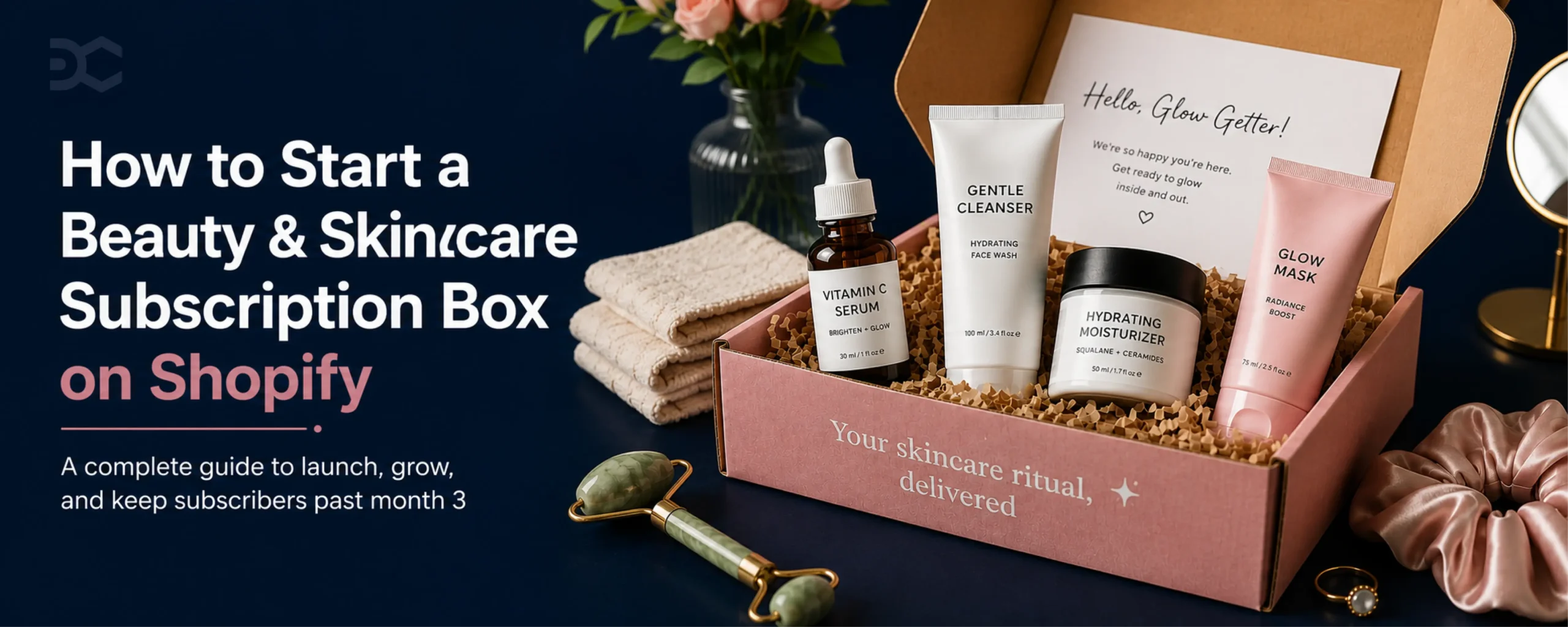
How to Start a Beauty & Skincare Subscription Box on Shopify and Keep Subscribers Past Month 3
- Updated: June 19, 2026
Table of Contents
Most beauty brands that try subscriptions on Shopify don’t fail because the tech is hard. They fail a few months in, when subscribers they worked hard to get start cancelling.
The setup is genuinely simple. You can get a product live with recurring billing in a day. The problem shows up later, around the third month, when people have enough products stacked up or just lose interest, and they leave faster than new ones sign up.
That’s the part worth getting right before you launch. Knowing how to start a beauty & skincare subscription on Shopify is less about the setup steps and more about whether people stick around once they’re in.
The first real decision is what kind of subscription you’re running. A replenishment plan works when people reorder the same thing, like a moisturizer or a serum they go through every month. A curated box works when the appeal is discovery, new products they wouldn’t have picked themselves. Get the model right and the rest of building your subscription business, the pricing, the setup, the retention, follows from there.
Why beauty & skincare subscriptions are worth starting in 2026
People don’t buy moisturizer once. They run out, reorder, run out again, and most of that repeat money currently goes to whoever makes it easiest to buy.
A subscription is just you being that easy option. Instead of hoping someone remembers your brand when their serum runs low, the reorder happens on its own and the revenue lands every month without you chasing it. That predictability is the real draw. You stop guessing what next month looks like.
Beauty fits this better than almost any category, because the products get used up on a schedule. Skincare especially. A cleanser or a treatment someone likes becomes part of their routine, and a routine is something they’ll pay to keep without thinking about it. It’s one of the reasons skincare is among the most popular categories in beauty subscriptions.
The market itself is growing fast, though you’ll see very different size estimates depending on who’s counting. Every report agrees on the direction, and it’s up, driven by people wanting convenience and routines they don’t have to think about.
None of that growth helps you if subscribers leave after a few months, which is what usually happens. So the goal isn’t just launching a beauty subscription box and getting signups. It’s keeping them long enough to actually earn back what you spent acquiring them.
What a beauty and skincare subscription actually is
The difference between a sale and a subscription is who remembers to buy again.
With a normal store, every purchase starts from zero. Someone has to think of you, come back, and check out, every single time. Most won’t. They forget, they get distracted, or a competitor catches them first. A subscription removes that step. The customer agrees once, and the same product ships on a set schedule with the payment running automatically in the background.
That setup turns occasional buyers into steady, repeat revenue, which is the whole point of the beauty box subscription model. You’re not chasing the next order. You’re keeping one going.
Beauty works for this because the buying is already repetitive. A skincare routine runs on a clock. The average skincare reorder cycle is around three to four months, and faster for daily-use products like cleansers, which can run out in about six weeks. People are going to rebuy anyway. A subscription just makes sure they rebuy from you instead of whoever’s easiest that week.
It’s the same logic behind any recurring revenue business. Predictable income, less spent re-acquiring the same customer, and a clearer picture of what next month actually looks like.
Choose your model: replenishment or curated box
Before you price anything or touch Shopify, you have to settle what kind of subscription you’re actually running. There are two real options for beauty and skincare, and they behave completely differently once subscribers are in.
Replenishment: the same products, on repeat
A replenishment subscription sends a customer the products they already use, on a schedule. They picked the serum, they like the serum, and now it just shows up before they run out. This is the subscribe and save skincare model, and it works because the customer’s need doesn’t go away. They were going to rebuy anyway.
That built-in need is why the replenishment subscription model holds onto people. Monthly churn for replenishment categories typically runs under 4 to 7 percent, because nobody cancels something they genuinely keep using.
Curated box: discovery and surprise
A curated box is the opposite bet. Instead of the same thing every month, the subscriber gets a changing mix of products to try, usually picked around a theme. The appeal is the surprise, the sense of opening something new. Think Ipsy or Birchbox.
The catch is that novelty wears off. Once the excitement fades, or the products pile up unused, people leave. Curated and discovery boxes run much higher churn, commonly 10 to 15 percent a month, several times the rate of replenishment.
Which one fits you
Look at what you sell, not at which sounds more exciting.
If you make products people use up and reorder, like cleansers, serums, or shampoo, replenishment is the natural fit and the easier business to keep alive. If your draw is variety and discovery, especially if you’re curating other brands or indie samples rather than selling your own core line, the curated box matches what your customer actually wants.
You can run both later. Plenty of brands offer a replenishment plan for their staples and a discovery box for everything else. But starting with one clear model, built around how your product is actually used, beats trying to be both before you understand your own churn rate.
Is a beauty subscription box profitable?
Beauty subscriptions can be genuinely profitable, and the margins are better than most retail. Subscription boxes typically run 30 to 60 percent gross margin, and beauty sits near the top of that range, often 55 to 65 percent, because the products themselves are cheap to make relative to what people pay.
Good margin doesn’t mean easy money, though. The cost that quietly decides whether you make it isn’t the product. It’s acquisition.
Getting a new subscriber is expensive. Across subscription boxes, it costs somewhere around $70 to $135 to acquire one paying customer through paid channels. If that person cancels after two months, you lost money on them. If they stay a year, you made plenty. The entire business lives or dies on how long people stay, not on what each box costs to fill.
That’s why one number matters more than any other: how much a customer is worth over their lifetime versus what you paid to get them. The standard benchmark is a ratio of at least 3 to 1. For every dollar you spend acquiring someone, you want at least three dollars back over the time they stay subscribed. Below that, you’re buying customers you can’t afford. You can calculate your lifetime value for your own numbers rather than guessing.
There’s also the discount to plan for. Subscribers expect a small price break for committing, usually something modest off the regular price, and a first-box offer to get them in the door. Both are worth it, but only if your margin can absorb them and the customer sticks long enough to pay it back.
So the honest answer is yes, profitable, but not on signups alone. The profit is in retention, which is exactly where most beauty subscriptions fall apart. The difference between a subscriber and a one-time buyer only pays off if the subscriber actually stays one.
Do you need a license or FDA approval to sell skincare?
There’s no such thing as “FDA approved” skincare, and any brand claiming it is either confused or bending the truth. The FDA does not approve cosmetics or their ingredients before they go on sale. That’s worth knowing up front, because a lot of new sellers either panic about approval they don’t need or assume there are no rules at all. Both are wrong.
Here’s the real shape of it in the US. You don’t get products approved, but if you manufacture or process cosmetics, current rules under a law called MoCRA generally require you to register your cosmetic facility and list your products. Renewal and recordkeeping come with that.
Safety is on you, not the agency. The law puts the legal responsibility for a product being safe on the person selling it, which means keeping records that back up your ingredients and claims.
Some small businesses are exempt from the facility registration and listing steps, though that carve-out doesn’t cover higher-risk products, like anything used near the eyes, injected, or meant to be taken internally. Whether you make your own batches at home or use a private-label manufacturer changes who’s responsible for what, so it’s worth being clear on that before you launch.
None of this is legal advice, and the rules change. Before you sell, confirm what applies to your specific products with the FDA directly or a qualified compliance professional. Getting this right once is far cheaper than fixing it after a complaint.
Setting up your beauty subscription on Shopify
Shopify doesn’t run subscriptions on its own. You add a subscription app that handles the recurring billing, attach a plan to your product, and the charges run automatically from there. The setup works the same whether you’re running a coffee subscription or a skincare one, so what’s worth your attention here is what changes when the product is skincare.
Frequency is the decision people get wrong most often with beauty. Monthly is the default, but skincare doesn’t get used up at one speed. A cleanser might run out in six weeks, while a serum or treatment can last two to three months. Ship faster than someone uses the product and they end up with a shelf of backups, which is one of the most common reasons beauty subscribers cancel. Match the delivery cycle to how fast each product is actually used, and offer a few frequency options instead of forcing everyone onto monthly.
The second beauty-specific choice is whether you sell one product on repeat or a set the customer assembles. Inside most subscription apps you can offer single-product replenishment, the same serum every cycle, or a “build your own” routine where the subscriber picks a cleanser, a treatment, and a moisturizer. Replenishment is simpler to run and stickier. Build-your-own feels more personal and can lift the order value, but it adds complexity to fulfillment. Pick one to launch with.
How to price your beauty subscription
Price too low and the margins never work. Price too high and people never sign up. Most beauty subscriptions land somewhere between $20 and $35 a month, with the broader subscription-box range sitting around $25 to $45. That’s your sane starting window before you adjust for what you actually sell.
Start from your real cost, not a competitor’s price. Add up everything that goes into one delivery: the products, the box, packaging, and shipping. A useful sanity check is to price at roughly three times your product cost, but treat that as a floor rather than a formula, because it quietly ignores shipping, packaging, and app fees that eat into every box. Once those are in, aim for a gross margin around 45 to 52 percent, which is the healthy range for beauty.
How you present the price matters as much as the number. Beauty buyers judge a box by what they think it’s worth, so show them. A box that delivers more retail value than it costs, stated plainly, reads as a deal in a way a bare price never does. Small touches help too. A price like $29.95 consistently converts better than the rounded version, for no real cost to your margin.
Then there’s the discount question, and beauty has two to set. A modest ongoing price break rewards people for subscribing instead of buying one-off, and a stronger first-order offer lowers the barrier to that first signup. Keep the deeper discount on the first box only, and be clear the regular price kicks in after, so nobody feels surprised on delivery two.
One pricing decision does more for retention than any other: offering an annual plan. Monthly is easier to sell, but annual subscribers pay upfront, can’t lapse on a failed card, and stay far longer. A small discount to nudge people toward paying yearly is one of the most effective things you can do, and it’s worth enough to come back to when we get to keeping subscribers.
Packing and shipping your subscription boxes
The box that shows up at someone’s door is the only part of your business they actually touch. For the first few months you’ll probably pack it yourself, on a table, by hand, and that’s fine. It’s also where the unboxing matters more for beauty than almost any category, because beauty buyers photograph and share what they open. Clean packaging and a small considered touch inside do real marketing work that a plain mailer never will.
Self-packing stops making sense faster than most people expect. Once you’re shipping somewhere around 200 to 500 orders a month, the hours spent packing start costing you more than a fulfillment partner would. There’s no exact line. The real signal is when boxing orders is eating the time you should be spending getting and keeping subscribers. That’s when a third-party logistics provider, a 3PL, earns its fee by handling storage, kitting, and shipping for you.
Shipping is where margins quietly leak. Carriers often charge on dimensional weight, meaning a big, half-empty box can cost more to ship than its actual weight suggests. Right-size your packaging to the product so you’re not paying to send air. Then bake the real shipping cost into your subscription price from the start, because absorbing it later is how a profitable box turns unprofitable.
Your inventory job depends on the model you picked. Replenishment is the easier one to run, since you’re stocking the same few products and reordering against steady demand. A curated box is harder, because the contents change every cycle, so you’re sourcing fresh, forecasting how many you’ll need, and timing it all to a fixed ship window. Plan for that complexity before you promise a monthly surprise you then have to scramble to fill.
How to reduce beauty subscription churn
Almost everything that kills a beauty subscription happens early. Across subscription categories, 60 to 70 percent of subscribers who leave are gone between their first and third order, and 44 percent of all cancellations happen within the first 90 days. If you only fix one thing, fix the first three months.
The first box carries more weight than any other. It sets every expectation the subscriber will ever have, so it has to beat what they imagined, not just match what you promised. Spend disproportionately here. Pair it with a short welcome sequence that shows people how to actually use what they got, because a product sitting unused is a product they’ll cancel.
Make pausing easier than quitting
Most people who hit cancel don’t want to leave forever. They have too much product, money’s tight this month, or life got busy. When the only button is cancel, that temporary feeling becomes a permanent loss.
Give them a pause, a skip, or a frequency change before the cancel goes through. A subscriber who skips a month keeps their account, their preferences, and their relationship with you intact, and comes back with one click. Brands that add a pause option to the cancellation flow recover a meaningful share of subscribers who were only ever overwhelmed, not unhappy.
Win back the cancellations nobody chose
Here’s the churn most people never see: failed payments. A card expires, funds run short, a bank declines a charge, and the subscription quietly lapses. The subscriber never decided to leave. Across subscription businesses, this kind of involuntary churn makes up 20 to 40 percent of cancellations, and for subscription boxes it runs even higher.
This is the most recoverable churn there is, because the person still wants the product. Dunning handles it for you. When a payment fails, the system retries on a smart schedule, asks the subscriber to update their card, and keeps the subscription alive while it recovers. Skincare is especially exposed here, since lower-priced boxes lose more to small failed charges than most owners realize.
The one lever most beauty brands ignore
Offer an annual plan. It’s the highest-impact retention move available, and almost nobody in beauty uses it well. Annual subscribers pay upfront, so they can’t lapse on a failed monthly charge, and they simply stay longer. Paying yearly cuts monthly-equivalent churn dramatically compared to month-to-month billing. A modest discount to nudge people onto it pays for itself many times over.
None of this is guesswork you have to do alone. You can model what a few points of churn improvement actually does to your revenue with a churn rate calculator before you change anything. The brands that survive past month three aren’t the ones with the best products. They’re the ones who built pause, dunning, and an annual option in from day one, and then actually watched the numbers.
Choosing a subscription app for beauty
The app you pick decides what your subscribers can actually do, so judge it on what matters for beauty, not on the longest feature list. Four things carry the most weight.
Flexible billing comes first, because skincare doesn’t run on one schedule. You want easy monthly, every-other-month, and annual options without needing a developer each time you adjust them. Then the retention tools that this whole guide keeps coming back to: a customer portal where people can pause, skip, or swap on their own, and dunning that quietly recovers failed payments before they become lost subscribers. Last, analytics you can actually read, churn, retention, and lifetime value in one place, so you spot a problem in the numbers before it shows up in your revenue.
Most of the well-known apps clear this bar. Recharge, Loop, Appstle, Easy Subscriptions and Driftcharge all handle subscriptions on Shopify, and any of them can run a beauty subscription. They differ mostly on pricing, on how their portals are built, and on how much retention is baked in versus bolted on. The right one depends on your stage and your margins more than on any single feature.
How to market and launch your subscription
The product people see before they buy is rarely the product itself. For beauty, it’s the unboxing. Skincare subscriptions live and die on how they look being opened on TikTok and Instagram, which is why your packaging and that first reveal matter as much as what’s inside. Build the box to be filmed, and getting found gets easier.
That’s also why the strongest way to grow a beauty subscription is other people showing it, not you describing it. Send boxes to creators in your niche in exchange for an honest unboxing. Their audience trusts them in a way they’ll never trust your ad, and one good video can bring in more subscribers than a week of paid traffic. Make it easy to track by giving each creator their own discount code.
Your existing buyers are the cheapest subscribers you’ll ever get. Turning one-time buyers into subscribers is a different job than chasing new ones, but the conversion rate is higher because they already trust you. A simple referral offer, a reward for the subscriber and a discount for the friend, spreads through the exact people most likely to want what you sell.
Don’t launch to silence. Build a small waitlist before you go live so day one has momentum instead of crickets, and point your current customers to it first since they already trust you. Then let automation carry the early relationship. A short email and SMS sequence that confirms the order, builds anticipation before the first delivery, and checks in after it is what turns a nervous first-time subscriber into someone who stays.
Common questions about starting a beauty subscription
Are beauty subscription boxes profitable?
They can be, and the margins are healthy, often 45 to 52 percent gross on a box priced around $20 to $35. But the profit isn’t in the margin, it’s in how long people stay. Since acquiring a subscriber costs real money, you only make money on the ones who don’t cancel in the first couple of months, which is why retention matters more than the price tag.
Should I do a curated box or a subscribe-and-save model?
Let your product decide, not your preference. If you sell things people use up and reorder, like a cleanser or serum, subscribe-and-save fits and keeps people far longer. If your whole appeal is discovery and variety, especially curating other brands, a curated box is what that customer actually wants, just know it’s the harder model to retain.
Do I need FDA approval to sell skincare?
No. The FDA doesn’t approve cosmetics before they go on sale, so there’s no such thing as “FDA approved” skincare. Under current US rules you generally do have to register your facility and list your products if you manufacture them, and the responsibility for the product being safe sits with you. Some small businesses are exempt from registration, though that doesn’t cover higher-risk products like anything used near the eyes or meant for internal use. This isn’t legal advice, so confirm what applies to your products with the FDA or a professional before you sell.
What’s the $200 threshold on Shopify people mention?
It’s a billing quirk, not a rule about subscriptions or sales. On the Basic plan, Shopify sends you a fresh bill every time your app and usage charges add up past $200, so in a busy stretch you might see what looks like a duplicate charge. It isn’t an error, just how Shopify meters billing along the way.
Why most beauty subscriptions don’t survive past month three
Launching is the part everyone gets right. You install the app, the first orders come in, and for a few weeks it feels like you’ve cracked it. Then month three shows up. People have more product than they can use, the novelty’s gone, and they start cancelling faster than new ones sign up.
The brands that get past that didn’t have a better launch. They just dealt with the boring stuff early. They set sensible delivery timing so people weren’t drowning in product. They made it easy to pause instead of quit. They caught failed payments before they turned into lost customers. None of it is exciting and none of it matters on day one, which is exactly why most people skip it.
So if you take one thing from all this, make it that. Keeping subscribers is the actual work, not the thing you get to after the fun part. Plan for it now and you’ll still have a business when the people who didn’t have churned theirs away.
Ready to build a subscription that keeps subscribers?
Most beauty subscriptions don’t lose people because the product is bad. They lose them in the first 90 days, to forgotten reorders, failed payments, and a cancel button that’s easier to find than a pause. Driftcharge is built for exactly that: pause and skip instead of cancel, automatic failed-payment recovery, and annual plans, so the subscribers you worked to get actually stay.

Ganesh Pawar


Join the waitlist now
Limited early access. Early joiners receive additional discounts on premium features.
Discover how


You may also like

March 1, 2026
Best Buy Now Pay Later Apps for Shopify in 2026
September 16, 2026
10 Best Shopify Trust Badge Apps to Boost Conversions in 2026