How to Start a Subscription Business on Shopify
- Updated: May 28, 2026
Table of Contents
Stop starting from zero every month.
That is the reality for most Shopify merchants. You run a promotion, orders come in, and then silence. Next month you do it all over again. The same effort, the same spend, the same uncertainty.
If you have been looking at how to start a subscription business on Shopify, that cycle is exactly what you are trying to break.
By 2028 the subscription market is expected to reach $2.4 trillion. That is not just Netflix and Spotify. That is Shopify merchants selling coffee, pet food, skincare, and meal kits to customers who pay automatically every single month without being asked again.
The merchants building recurring revenue are not working harder than you. They just set up their business differently.
Eight practical steps ahead. Everything from picking the right niche and setting your pricing to choosing the right app and keeping subscribers from cancelling. No fluff, no theory. Just what works on Shopify in 2026.
If you already have a Shopify store and you are ready to stop depending on one-time sales, you are in the right place.
What is a Subscription Business on Shopify?
Most Shopify stores are built around a single transaction. A customer finds you, buys once, and disappears. You spend money finding the next one and repeat the cycle indefinitely.
A subscription business breaks that cycle.
Instead of selling once and starting over, you sell once and keep getting paid. Your customer agrees to a recurring schedule, weekly, monthly, or quarterly, and you deliver consistently. The payment happens automatically and the relationship compounds over time.
Every month you keep a subscriber is a month you did not have to pay to reacquire them.
That is the core difference between one-time sales and recurring revenue. One resets to zero every month. The other builds on itself.
The reason Shopify works so well for this is infrastructure. It runs on a native subscription API that connects directly to your checkout, supports recurring billing through major payment gateways, and plugs into 50+ apps built specifically for subscription management. You are not hacking a one-time sales platform into doing something it was not designed for. Shopify was built with this in mind.
The subscription business model itself is not new. Magazines, gyms, and software companies have run on it for decades. What changed is that physical product brands can now run it just as easily. A skincare brand, a coffee roaster, a pet supply store. All of them can now offer the same predictable automated revenue that software companies have enjoyed for years.
That is what you are building here.
3 Types of Subscription Models — Which One Fits Your Store
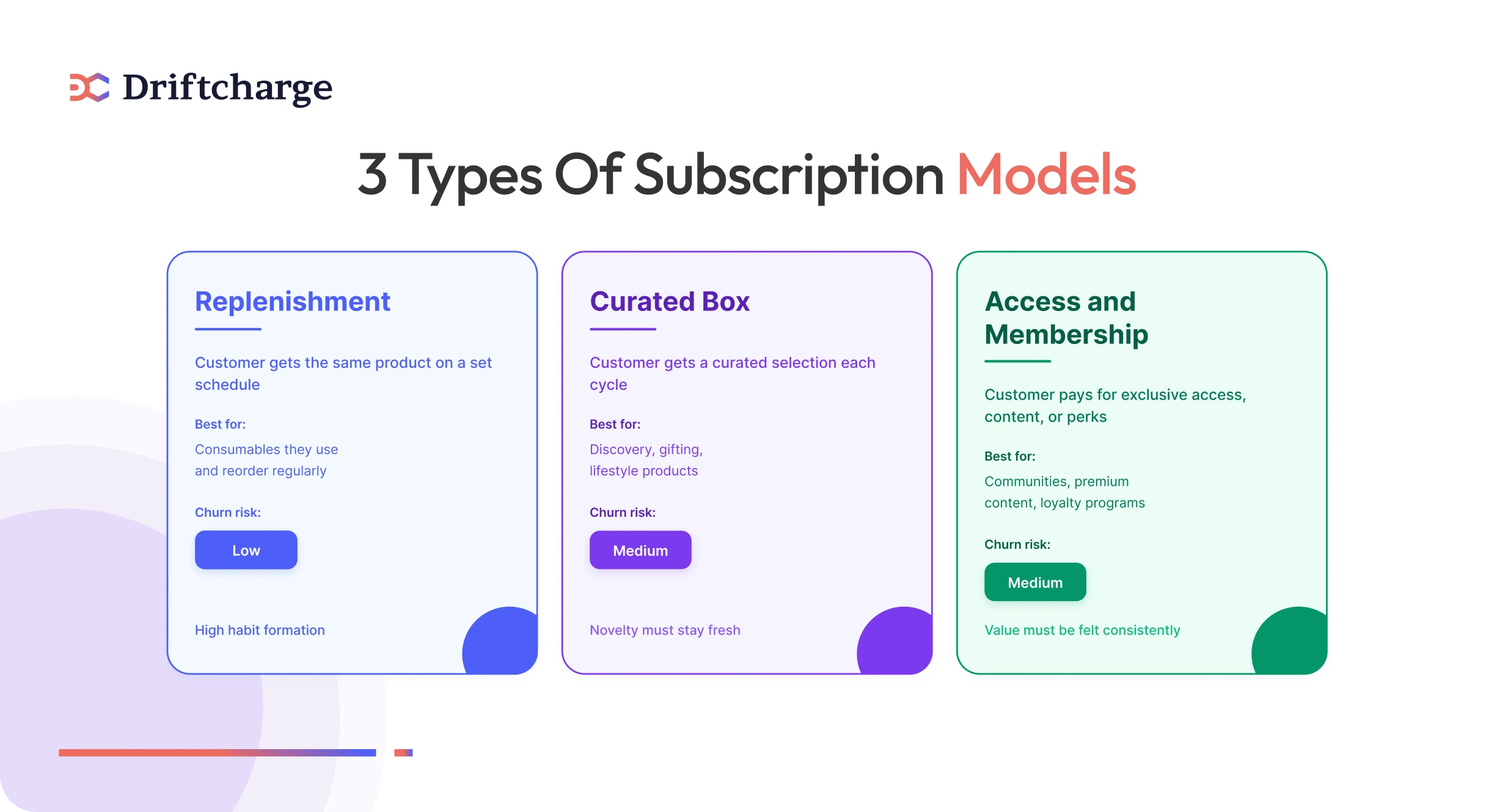
Not every product suits every subscription model. Before you set anything up, you need to know which model fits what you sell. There are three. Each one works differently and attracts a different type of subscriber.
| Model | How it works | Best for | Churn risk |
|---|---|---|---|
| Replenishment | Customer gets the same product on a set schedule | Consumables they use and reorder regularly | Low — high habit formation |
| Curated box | Customer gets a curated selection of products each cycle | Discovery, gifting, lifestyle products | Medium — novelty must stay fresh |
| Access and membership | Customer pays for exclusive access, content, or perks | Communities, premium content, loyalty programs | Medium — value must be felt consistently |
Replenishment subscriptions
This is the simplest model and often the stickiest. Your customer runs out of something regularly and instead of reordering manually every time, they set it up once and forget about it. Coffee, pet food, supplements, skincare. Products that get used up and need replacing on a predictable cycle. The subscriber stays because stopping the subscription means running out of something they need. If you sell consumables, this is the model to start with.
Curated box subscriptions
This model runs on excitement. Your subscriber does not know exactly what they are getting each cycle and that is the point. The thrill of discovery keeps them opening the box every month. A meal kit subscription business, lifestyle boxes, beauty samples, hobby supplies. The challenge is maintaining that sense of surprise without the quality ever dropping. The moment the box feels predictable or underwhelming, cancellations follow.
Access and membership subscriptions
Instead of shipping a physical product, you are selling access. Exclusive content, a private community, early releases, member-only pricing. The subscriber is paying to belong to something, not just to receive something. This model works well alongside a physical product business as an add-on tier, but it can also stand alone. The perceived value needs to be felt every single month or the subscriber sees no reason to stay.
Is a Subscription Model Right for Your Shopify Store?
Not every product belongs in a subscription. Selling something once is very different from convincing someone to pay for it every month automatically. Before you build anything, answer one question honestly.
Would your customer buy this every month without being asked?
If the answer is yes, you have a subscription product. If you hesitated, the five criteria below will help you decide.
1. Consumables with a predictable refill cycle work best because when the product runs out the need automatically comes back and the subscription replaces the manual reorder. Coffee, supplements, skincare, and pet food all follow this pattern. The less the customer has to think about reordering the stronger the model.
2. Consistent year-round demand keeps subscribers paying. Seasonal products cause customers to cancel in the off months and resubscribe when the season returns, which destroys retention numbers. If people want your product every month without a seasonal reason to stop, you are in a strong position.
3. The value of staying subscribed needs to be felt without being explained. If you find yourself having to remind customers why the subscription is worth it, the product is not making the case on its own. The best subscription products speak for themselves on delivery day.
4. Products that fit into an existing daily or weekly routine retain better than those that do not because the subscription slots into a habit the customer already has rather than asking them to build a new one. A morning coffee subscription or a monthly supplement refill works because the routine already existed before the subscription did.
5. There needs to be a delivery frequency that feels logical. Monthly works for most consumables, weekly works for food, quarterly works for premium or high cost items. If you cannot land on a natural frequency without forcing it, the subscription model may need more thought before you build it.
Step 1 — Choose Your Niche and Validate Demand
The merchants who struggle with subscriptions usually picked a niche because they liked the idea of it. The ones who succeed picked a niche because the data told them to.
Before you build anything, validate that real people are actively looking for what you want to sell on a recurring basis. Google Trends will show you whether interest in your niche is growing, flat, or fading. Reddit communities in your niche will show you what people actually complain about, ask for, and spend money on. And if competitors are already running a subscription in your space and growing, that is the strongest validation of all. You do not need to be first. You need to be better.
The niches consistently performing well for subscription businesses on Shopify in 2026 are beauty and skincare, wellness and supplements, pet supplies, coffee subscription business, meal kit subscription business, food and snacks, and fitness. These are not the only options but they share a common trait. The customer has a regular, predictable need that does not go away.
What is the best niche for a subscription box business
The best niches for a subscription box business are ones where the customer has a recurring need, a genuine interest in discovery, or both. Beauty, wellness, pet, food, and coffee consistently outperform other categories because they combine habitual use with room for curation and surprise. If your niche has an active community, existing competitors doing well, and a product that gets used up or refreshed regularly, you are in the right space.
How to choose your subscription frequency
Frequency is not a branding decision. It is a product decision.
Weekly works for food and meal kits because the customer needs fresh product regularly and a week is a natural consumption cycle. Monthly works for beauty, wellness, pet, and lifestyle products where the customer uses the product steadily but not daily. Quarterly works for premium or higher cost items where the perceived value needs time to be fully appreciated before the next charge.
The wrong frequency kills retention before any tool gets a chance to help. If your customer receives product faster than they can use it, they cancel. If they run out before the next delivery, they feel underserved. Match your subscription frequency to the actual consumption rate of your product, not to what works best for your fulfilment schedule.
Step 2 — Set Up Your Shopify Store for Subscriptions
Most merchants assume their Shopify store is ready for subscriptions the moment they decide to offer them. It is not. There are a few things to check and confirm before you install anything.
Start with your Shopify plan. Basic and above supports subscription functionality. If you are on a legacy or trial plan, upgrade before going any further because subscriptions require a paid plan with full checkout capabilities.
Your theme matters too. Subscription apps work with Shopify 2.0 themes only. If your store is running an older theme the subscription widget will not display correctly on your product pages. Check your theme version in your Shopify admin under Online Store and switch to a 2.0 compatible theme if needed. Most modern Shopify themes already meet this requirement.
The third thing to confirm is your payment gateway. Not every gateway supports recurring billing and this is where a lot of merchants get stuck after they have already set everything else up.
What payment gateways support Shopify subscriptions
Six payment gateways currently support recurring billing on Shopify. Shopify Payments, Stripe, ShopPay, PayPal Express, Apple Pay, and Authorize.net. If you are not using one of these, subscriptions will not process automatically. Shopify Payments is the most straightforward option because it is built directly into your store with no additional setup required.
How to set up recurring billing on Shopify
Four things to confirm before you go live. First, make sure you are on a paid Shopify plan. Second, check your theme is Shopify 2.0 compatible. Third, confirm your payment gateway is one of the six that support recurring billing. Fourth, install a subscription app, which the next section covers in full.
Auto-renewal and customer consent settings are handled inside the subscription app you choose. Most apps include a consent checkbox at checkout automatically but make sure it is switched on before you go live. In many regions it is a legal requirement, not just good practice.
Step 3 — Choose the Right Shopify Subscription App
Shopify does not process recurring payments on its own. A one-time purchase goes through checkout and that is the end of the transaction. For a subscription, you need an app that sits between your store and your payment gateway, manages the billing schedule, handles customer accounts, and keeps the whole operation running automatically every month.
The app you choose will shape your subscriber experience more than any other decision you make.
Does Shopify support subscriptions natively
Shopify has a basic native subscription feature but it is limited. It handles simple recurring billing but lacks a customer portal, churn prevention tools, dunning management, and the analytics a growing subscription business needs. For anything beyond a basic setup, a dedicated subscription app is the right call.
What to look for in the best Shopify subscription app
The first thing to check is billing flexibility. Your customers are not all the same and you need to offer weekly, monthly, quarterly, prepaid, and trial options without needing a developer every time you want to change something.
Beyond billing, look at what happens after the customer subscribes. A self-serve customer portal where subscribers can pause, skip, swap products, or update their payment details on their own reduces your support tickets and keeps cancellation rates down. Paired with that, the app needs proper churn prevention tools that intercept a cancellation before it is processed, not after.
Analytics matter more than most merchants realise when they are starting out. MRR, churn rate, LTV, and subscriber behaviour should be visible in one place without exporting anything to a spreadsheet. And when a payment fails, dunning management should handle the retry, the customer notification, and the recovery automatically. Every declined card that goes unmanaged is a subscriber you lose without knowing it.
Finally, check how well the app integrates with the tools you already use. Email platforms, loyalty apps, and analytics should connect without manual work so your subscription data flows into the rest of your business from day one.
Driftcharge is a Shopify subscription app built around all of these requirements, without the enterprise pricing that comes with most tools in this space.
How to add subscriptions to your Shopify store
To add subscriptions to your Shopify store, follow these steps:
- Install your chosen subscription app from the Shopify App Store and connect it to your payment gateway.
- Create your subscription rules covering frequency options, discount structure, and any trial settings you want to offer.
- Add the subscription widget to your product pages and anywhere else you want subscribers to be able to sign up.
The whole setup takes less than a day. The subscription management side, the ongoing billing, customer communications, and retention flows, runs automatically from that point forward.
Step 4 — Create Your Subscription Plans and Pricing
Getting your subscription pricing strategy wrong is one of the fastest ways to kill retention before it starts. Too high and you lose people at signup. Too low and you cannot sustain the business. The number you land on needs to make sense for your margins, your customer, and the value they are getting every single month.
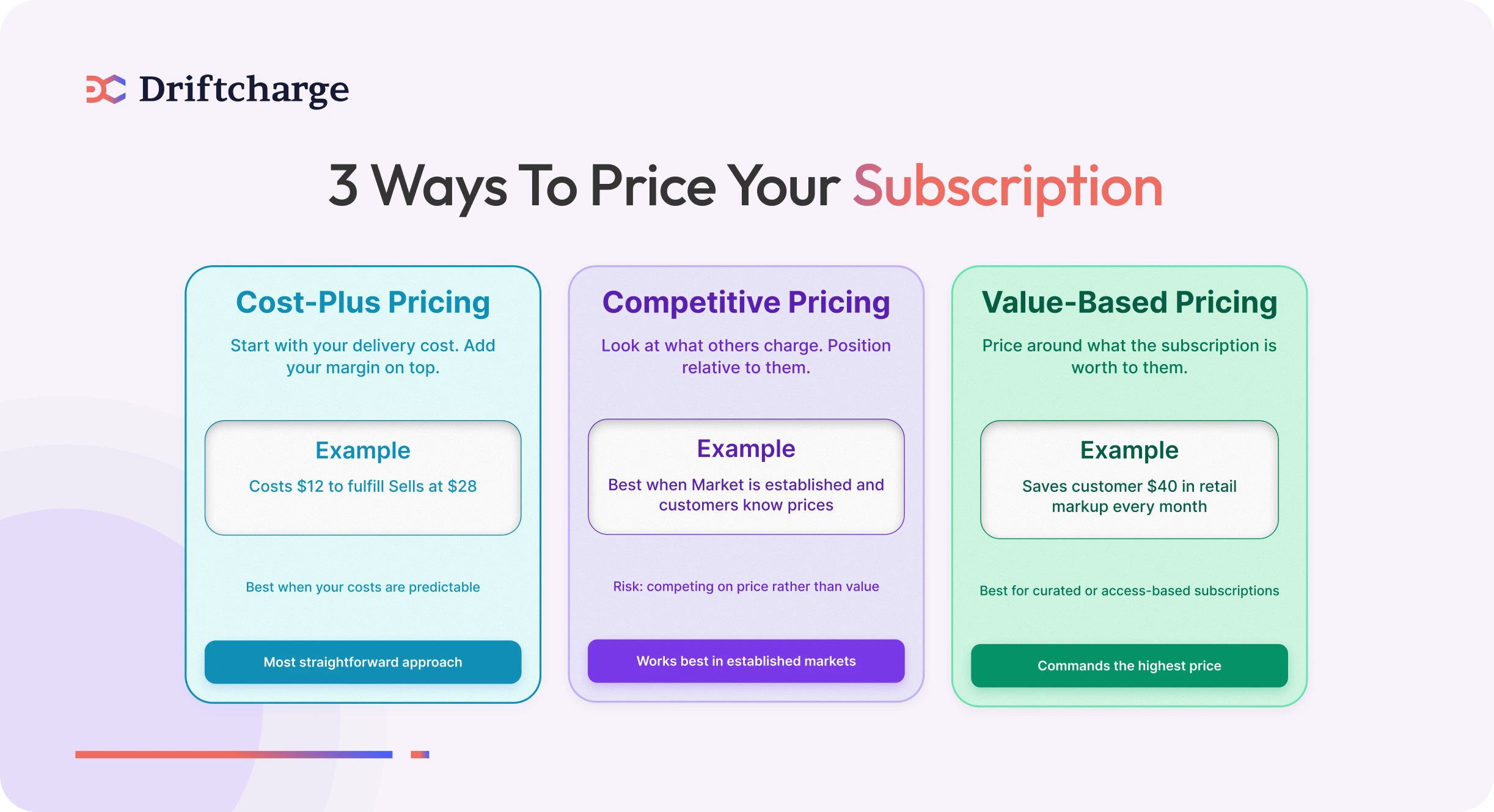
There are three ways to approach subscription pricing.
Cost-plus pricing starts with what it costs you to deliver the subscription, product, packaging, shipping, and fulfilment, and adds a margin on top. It is the most straightforward approach and works well when your costs are predictable. A coffee subscription that costs you $12 to fulfil and sells at $28 gives you a healthy margin while staying competitive.
Competitive pricing looks at what others in your niche are charging and positions you relative to them. This works best when your market is established and customers already have a reference point for what subscriptions in your category cost. The risk is competing on price rather than value.
Value-based pricing is built around what the subscription is worth to the customer, not what it costs you to deliver. This works best for curated or access-based subscriptions where the experience itself justifies a premium. A wellness subscription that saves a customer two hours of research and $40 in retail markup every month can command a higher price than its component cost suggests.
Can I offer a free trial on Shopify subscriptions
Yes. Free trials on Shopify subscriptions are set up inside your subscription app under the subscription rules for each product. You define the trial length, what happens at the end of the trial period, and whether a payment method is required upfront. The key is keeping the trial period short enough to convert quickly but long enough for the customer to experience the value of the subscription before they are charged.
Prepaid vs monthly — which should you offer
Monthly subscriptions are easier to sell because the commitment feels smaller. Prepaid subscriptions, where the customer pays for three, six, or twelve months upfront, are harder to sell but significantly better for your business. Prepaid subscribers have a lower churn rate because the payment is already made, a higher LTV because they commit to a longer cycle, and cost less to retain because the involuntary churn risk from failed monthly payments disappears.
The best approach is to offer both and incentivise prepaid with a discount. A 10 to 15 percent reduction on an annual subscription is enough to shift a meaningful portion of your subscribers to the prepaid option without hurting your margins. Use tiered discounts to reward longer commitments and you create a natural upgrade path within your own subscriber base.
First order discounts between 10 and 20 percent work well for initial conversion. They lower the barrier for a first-time subscriber without setting a price expectation that is hard to maintain. Keep the discount on the first order only and communicate clearly that the regular price applies from the second delivery onwards.
Step 5 — Set Up Your Subscription Widget and Checkout
Your subscription widget is the first thing a potential subscriber interacts with. If it is buried on the page, unclear about what is being offered, or slow to load on mobile, you lose the signup before the customer has even made a decision. Placement and presentation matter more than most merchants expect.
The product page is where most subscription signups happen. Your widget needs to sit prominently next to the add to cart button, clearly show the subscription options alongside the one-time purchase price, and make the recurring discount obvious. If the subscriber cannot immediately see why the subscription is a better deal than buying once, they will buy once.
Beyond the product page, your widget can sit on your homepage banner, collection pages, and any landing page you are driving paid traffic to. The more places a visitor can convert to a subscriber without having to navigate to a specific product page, the higher your overall subscription conversion rate.
Mobile is where you cannot afford to get this wrong. The majority of Shopify traffic today comes through mobile and subscription signups follow the same pattern. Your widget needs to load fast, display correctly on smaller screens, and require as few taps as possible to complete the signup. Test it on your own phone before you go live. If anything feels slow or unclear, fix it before you start driving traffic.
Shopify subscription customer portal
Every subscriber you acquire will eventually need to change something. Their address, their payment method, their delivery frequency, or their product selection. If they have to contact your support team to do any of these things, you are creating friction that leads directly to cancellations.
A customer portal gives subscribers full control over their subscription without involving your team. They can pause, skip a delivery, swap products, update billing details, or cancel entirely from one place. The merchants who see the lowest churn rates are almost always the ones who make subscription management the easiest experience possible for the subscriber.
Checkout upsells and post-purchase subscription offers
Not every subscriber will come through your product page widget. A large portion of your subscription growth will come from converting customers who already bought from you once. The checkout and post-purchase moments are where that conversion happens most naturally.
At checkout, a Shopify upsell and cross-sell app that shows the subscriber price alongside the one-time price gives the customer a clear reason to switch. After purchase, a post-purchase offer that invites the customer to turn their order into a recurring subscription captures buyers who were not thinking about subscriptions when they arrived.
Step 6 — Get Your First Subscribers Before You Even Go Live
The biggest mistake merchants make when launching a subscription is treating it like a product launch. You build it, you announce it, and you wait for signups. That approach works for one-time products. For subscriptions it leaves you starting from zero with no momentum and no social proof.
Build demand before you go live.
A pre-launch waitlist does two things. It tells you whether real interest exists before you invest in fulfilment and inventory, and it gives you a warm audience to convert on day one instead of launching to silence. A simple landing page with an email capture and a clear value proposition is enough. Drive your existing customers to it first. They already trust you and they are your most likely early subscribers.
Your email onboarding sequence is what separates subscribers who stay from subscribers who cancel in the first 30 days. The first email should arrive immediately after signup and confirm exactly what they signed up for, when their first delivery arrives, and how to manage their subscription. The second email, sent a day or two before the first delivery, builds anticipation. The third, sent after delivery, asks for feedback and reminds them what is coming next. Most merchants skip this sequence entirely and wonder why early churn is high.
Your existing customer base is the most underused acquisition channel for subscriptions. Someone who has already bought from you once has already trusted you with their money. Turning existing customers into subscribers requires a different approach than acquiring new ones, but the conversion rate is significantly higher because the trust barrier is already gone.
Step 7 — Why Most Subscribers Leave and How to Stop Them
Acquiring a subscriber is the beginning of the work, not the end of it. Most subscription businesses focus almost entirely on acquisition and treat retention as something that happens automatically. It does not. The merchants who build real recurring revenue treat keeping a subscriber as seriously as getting one.
The 90-day subscriber drop-off problem
The first 90 days decide everything. Understanding why subscribers drop off in the first 90 days is what separates a subscription business that grows from one that slowly goes quiet. Those who cancel almost always do it in the first cycle or two, usually because the value of the subscription was not felt quickly enough or because something in the experience created friction.
Shopify subscription pause instead of cancel
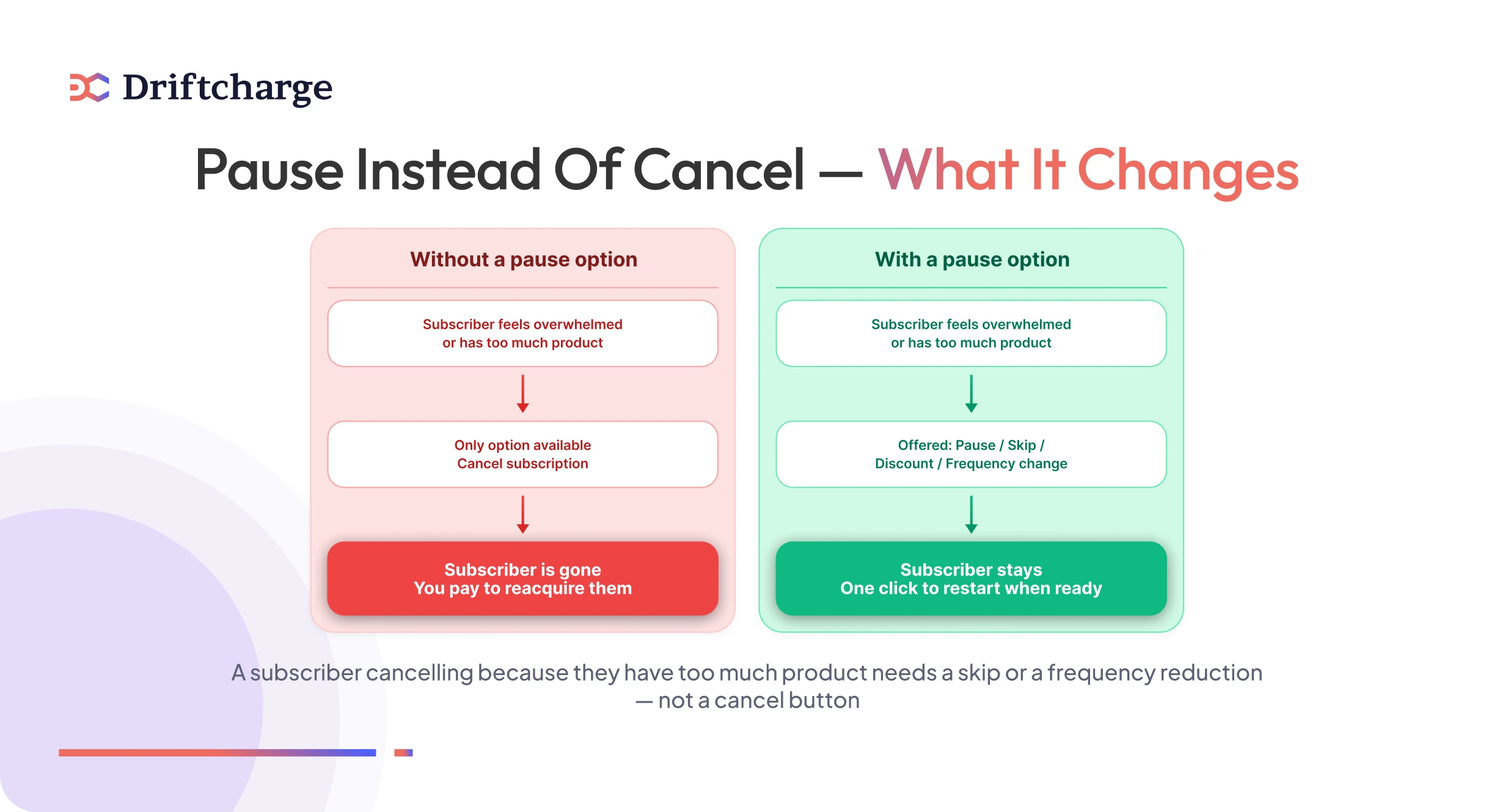
When a subscriber hits the cancel button, the default assumption is that they want to leave. Most of the time they do not. They are overwhelmed, they have too much product, they are going through a busy period, or they just need a break. Giving them the option to pause instead of cancel intercepts that moment before it becomes a permanent decision.
Merchants who add a pause option to their cancellation flow consistently recover subscribers who were about to leave for the wrong reasons. The subscriber keeps their account, their preferences, and their relationship with your brand intact. When they are ready to restart, one click brings them back. Without the pause option, that subscriber is gone and you are paying to reacquire them.
How to prevent subscription churn on Shopify
A subscription cancellation flow that just asks “are you sure?” is not a retention tool. It is a formality. A proper cancellation flow presents the subscriber with options before confirming the cancel. A pause. A skip. A discount on their next order. A frequency change. Each option addresses a different reason for cancelling and gives the subscriber a path to staying that requires less commitment than continuing as normal.
Retention offers work best when they are targeted. A subscriber cancelling because they have too much product needs a skip or a frequency reduction. A subscriber cancelling because of price needs a discount. Showing the same offer to every cancelling subscriber is better than showing nothing but it leaves retention on the table.
Involuntary churn — failed payment recovery and dunning
Not every cancellation is a choice. A significant portion of subscription churn comes from failed payments, expired cards, and insufficient funds. The subscriber never decided to leave. Their payment just did not go through and the subscription lapsed before anyone addressed it.
Involuntary churn is the most preventable form of churn because the subscriber still wants the subscription. Dunning management handles this automatically. When a payment fails the system retries the charge on a set schedule, sends the subscriber a notification to update their payment details, and keeps the subscription active while the recovery process runs. Without dunning, every failed payment is a silent cancellation that never shows up as a deliberate decision but still costs you a subscriber.
Most subscription apps offer some form of dunning but the quality varies significantly. Look for automatic retry logic with configurable timing, customer notifications that are clear and non-alarming, and a recovery window that gives the subscriber enough time to update their details before the subscription is cancelled.
Step 8 — MRR, Churn, and LTV: The Only Numbers That Matter
Most merchants running a subscription business know their monthly revenue. Very few know whether that revenue is growing, shrinking, or about to fall off a cliff. The difference between the two is knowing which numbers to look at and what they are telling you.
Four metrics matter more than everything else.
Monthly recurring revenue is the baseline. It tells you the predictable income your subscription generates each month before any one-time purchases are counted. Annual recurring revenue, your MRR multiplied by twelve, gives you the bigger picture and is the number most investors and partners will ask about first. If your MRR is growing month on month, the business is healthy. If it is flat or declining, something upstream is broken, either acquisition has stalled or churn is quietly eating your gains.
Churn rate is the number most merchants avoid looking at because it is uncomfortable. A healthy subscription business runs at under 5% monthly churn. Above that and you are losing subscribers faster than you can replace them. Track your churn rate regularly and you will see problems forming weeks before they hit your revenue.
Your LTV to CAC ratio tells you whether your acquisition spend is sustainable. A ratio of 3:1 means you are generating three dollars of lifetime value for every dollar you spend acquiring a subscriber. Below that and your economics are fragile. Above it and you have room to scale aggressively.
Customer lifetime value for subscription businesses
Customer lifetime value is the total revenue a subscriber generates from their first payment to their last. The simple formula is average order value multiplied by purchase frequency multiplied by average customer lifespan. For a subscriber paying $30 per month who stays for 14 months, the LTV is $420. Knowing that number tells you exactly how much you can afford to spend acquiring each subscriber and still run a profitable business. Calculate your subscriber LTV to get your actual number before you start scaling acquisition spend.
When to scale your subscription business
Scaling before your subscription business is stable is one of the most common and costly mistakes in ecommerce. More traffic into a leaky bucket does not fix the leak, it just empties your budget faster.
The signal that tells you the business is ready to scale is when all three metrics are moving in the right direction at the same time. MRR growing, churn under 5%, LTV to CAC at 3:1 or above. At that point adding acquisition spend accelerates something that is already working rather than propping up something that is not.
Questions Shopify Merchants Ask Before Starting a Subscription Business
Why are people cancelling subscriptions
Most subscribers don’t cancel because they hate the product. They cancel because they have too much of it and no easy way to slow things down. If a customer can’t skip a shipment or pause without hunting for a cancel button, canceling becomes the only option they can find. Failed payments are another silent killer. If a card declines and no one follows up, that subscriber disappears without ever intending to leave.
Why do subscription services fail?
Usually not with a dramatic moment, just churn slowly outpacing new signups until the numbers stop working. The common pattern is pricing that makes sense at launch but loses its value by month three, no process for recovering failed payments, and zero flexibility for subscribers who want to slow down rather than quit. Getting subscriptions right is less about the product and more about what happens after someone signs up.
How much does it cost to start a subscription business on Shopify?
Less than most merchants expect. Shopify’s paid plans start at $39 per month and subscription apps range from free entry tiers up to $100 or more depending on your subscriber volume and feature needs. Most merchants launching their first subscription on Shopify spend between $100 and $300 per month on platform and tooling before factoring in product and fulfilment costs. The subscription model does not require heavy upfront infrastructure. You are building on top of what Shopify already handles.
What are the drawbacks of a subscription business model?
The one most merchants don’t see coming is how fast churn compounds. Acquiring a subscriber costs real money, and if they leave in month two, you likely haven’t broken even yet. Billing also gets messy without a proper system. Expired cards, failed charges, and refund requests pile up fast. The model works well when you build flexibility in from day one, because subscribers who can pause or adjust their plan almost always stay longer than those who feel stuck.
Can I migrate my existing subscriptions to Shopify?
Yes, and it is more straightforward than most merchants expect. The process involves exporting your subscriber data from your current platform, whether that is Recharge, Bold, or something else, mapping it to your new Shopify subscription app, and importing it without disrupting active billing cycles. The key is making sure your subscribers’ payment details and billing schedules transfer cleanly so the transition is invisible to them. Look for a subscription app that offers bulk import support and dedicated migration guidance rather than leaving you to figure it out alone.
The Subscription Business That Pays You Every Month Starts Here
The eight steps are done. You have a niche, a pricing model, an app, a widget, and a plan for keeping subscribers from leaving. That is more than most merchants have when they hit publish.
But the setup is the easy part. The merchants who build real recurring revenue are the ones who keep showing up after launch. They watch the churn numbers every month. They fix the cancellation flow when it stops working. They test a new frequency option when retention dips. They treat the subscription as something that needs work, not something that takes care of itself.
The ones who skip that part end up with a flat MRR and no clear reason why. The ones who do not skip it build something that pays them every month without starting from zero each time.
Most merchants start a subscription business and stall at a few hundred MRR because retention was never built properly from day one. Driftcharge is being built to fix that from the start.

Ganesh Pawar


Join the waitlist now
Limited early access. Early joiners receive additional discounts on premium features.
Discover how


You may also like

January 7, 2026
Gift Subscriptions on Shopify: Your 2026 Holiday Growth Guide